When Faith Leaves Earth
How Buddhism, Hinduism, Islam, and Christianity adapt when humanity moves beyond its home planet
30 January 2026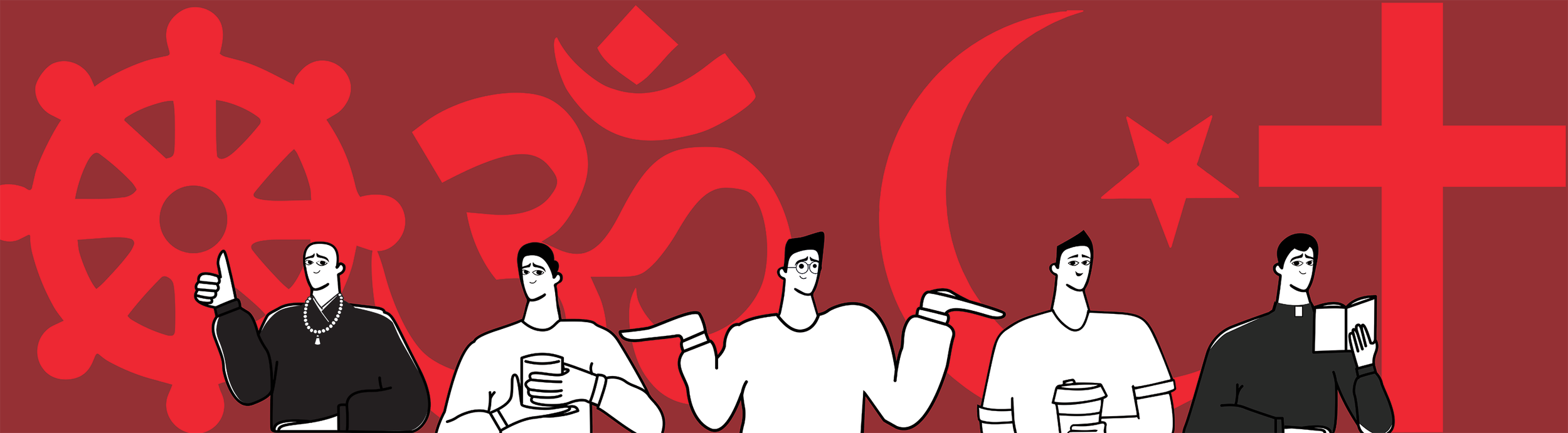
At some point, humanity will step far enough away from Earth that the planet will stop behaving like a backdrop and start behaving like a memory.
Mars is that distance.
From there, Earth is no longer beneath your feet or overhead in the night sky. It is a moving point of light, sometimes visible, sometimes gone altogether. Seasons no longer match. Days stretch. Silence lengthens. Survival depends not on familiarity but on systems—engineered, fragile, constantly monitored. Nothing about the environment reassures you that you belong there.
For decades, conversations about Mars have focused on propulsion, radiation, habitats, and fuel. These are necessary questions. They are also incomplete. Because long before humans decide whether they can live on Mars, they will have to learn how to live with themselves there.
Religion enters that conversation not as doctrine or dogma, but as infrastructure for meaning. Not answers to cosmic mysteries, but tools for endurance. Every major religious tradition emerged as a response to conditions humans could not control: uncertainty, suffering, impermanence, injustice, isolation. Mars concentrates those conditions rather than introducing new ones.
What happens to faith when it loses its scenery?
When sacred geography is inaccessible?
When ritual becomes expensive?
When community is unavoidable and solitude is relentless?
To explore those questions, I spoke with four thinkers rooted in four of the world’s most widely practiced religious traditions. A Buddhist monk who understands silence as practice rather than absence. A Hindu scholar for whom Mars barely registers against cosmic time. A Muslim public intellectual who sees adaptation as Islam’s defining strength. And a Catholic priest who treats displacement not as crisis, but as a recurring chapter in Christian history.
Together, these conversations reveal something unexpected. Mars does not threaten religion. It clarifies it.
Stripped of cultural dominance, architectural grandeur, and geographic familiarity, belief systems are forced to reveal what they actually do. Which practices help people endure waiting. Which ethics hold under scarcity. Which ideas about self, community, and meaning survive when Earth is no longer the center of experience.
Mars will not tell humanity what to believe.
But it will expose which beliefs were always doing the real work.
What follows is not a comparison of religions, nor an argument for or against faith beyond Earth. It is a set of encounters—four traditions, four voices, four ways of understanding what remains when humans carry their inner worlds to a planet that offers nothing in return.
“Just as a bird flies wherever it wills, leaving no track behind, so too the awakened one moves freely.”
Buddhism: Sitting with the long silence
The moment that stays with me arrives quietly, midway through the conversation, long after we’ve drifted away from formal definitions.
We are talking about communication delays between Earth and Mars. Sometimes three minutes. Sometimes twenty-two. Long enough to send a message, stare at the screen, and begin inventing stories about what the silence means. Long enough for reassurance to feel late. I ask, almost casually, how people are supposed to live with that kind of waiting.
Vasu Bandhu does not answer immediately.
When he does, he doesn’t talk about Mars at all.
“Buddhism teaches us, through meditation, through mindfulness,” he says, “to be okay with one’s self, to listen yourself and to appreciate and observe everything that is part of yourself, of your own mind.”
Only later does it become clear that we had already reached the center of the question.
Mars will be full of waiting.
A Practice Learned in Motion
Vasu Bandhu does not speak like someone whose spiritual life unfolded in seclusion. His path into Buddhism began in motion, shaped by movement across borders rather than retreat from the world. “I’m from Mexico,” he tells me, “and I am an immigrant from five years ago to the United States.” Long before becoming a monk, he was already navigating difference as a way of life. “When I was 18, I was living in Central America, and I started collaborating with interfaith organizations… and I learned the importance of interfaith collaboration for peace.”
Buddhism, for him, was not inherited. It was discovered slowly, through proximity to difference rather than withdrawal from it. “Something that called me from Buddhism,” he says, “is the learnings on living in harmony with the diversity of everything. The learnings of interdependence and interconnection.” That language matters on Mars, where coherence will be fragile and diversity unavoidable. Small crews will arrive carrying different cultures, expectations, and ways of coping under pressure. Buddhism, as Vasu Bandhu describes it, does not offer a blueprint for agreement. It offers a way to remain attentive when agreement fails. “Interconnection and interdependence,” he says, “is very open to all identities.”
When Suffering Is Not a Surprise
Buddhism begins with an observation so simple it is often mistaken for pessimism.
“For me, in my personal experience,” Vasu Bandhu says, “Buddhism is one way to discover the suffering and how to alleviate the suffering in life.” On Earth, that can sound philosophical. On Mars, it will sound descriptive. Isolation will not be temporary. Risk will not fade with familiarity. Systems will fail. Days will stretch without novelty. The planet will not soften over time.
The Four Noble Truths surface in the conversation not as doctrine to be memorized, but as a working framework for navigating reality when it refuses to cooperate. Buddhism begins by naming what is already present: suffering exists. Not as a failure or a moral flaw, but as a condition of being alive. From there, it asks where that suffering comes from—not from Mars itself, or from hardship alone, but from the mind’s habit of resisting what is happening. “To discover the suffering in yourself,” Vasu Bandhu explains. “To understand our suffering… and to navigate the suffering, to alleviate and to be free from the suffering.”
That sequence matters. First recognition. Then understanding. Then response. Buddhism does not deny pain, confinement, fear, or loss. It asks what happens when humans add a second layer on top of those experiences: the suffering that comes from wanting reality to behave differently. Wanting permanence from systems designed to degrade. Wanting comfort from an environment that cannot provide it. Wanting reassurance on a timeline that physics will not honor. The Fourth Noble Truth—the path—does not promise escape from hardship. It offers a way of relating to it skillfully, so suffering does not compound itself into blame, resentment, or despair.
Buddhism does not eliminate desire. It teaches how to see it clearly, so it no longer dictates the terms of experience.
Time That Refuses to Hurry
On Earth, silence often feels accidental. On Mars, it will be structural. Messages will travel slowly. Responses will lag. Even emergencies will unfold with delay built in, and the mind will not experience this as neutral space. It will fill it. “That example,” Vasu Bandhu says, referring to long communication delays, “is a good opportunity for people to be okay with one’s self, to observe themselves.”
Meditation, in this context, is not about calm. It is about literacy. It is learning how the mind behaves when stimulus drops away, how quickly it invents narratives, how convincingly it fills gaps with fear or certainty. Mars will stretch time in ways few Earthly environments ever have. Buddhism has spent centuries sitting inside stretched time without trying to collapse it. Waiting does not become pleasant. It becomes legible.
Living With No Elsewhere
Community emerges less as a topic than as a pressure that grows harder to ignore. On Mars, there will be no casual distance, no stepping away from conflict, no anonymity. Every irritation will echo. Every unspoken tension will linger. Buddhism does not romanticize this reality. It names it directly. “We have three principles that are important for Buddhists,” Vasu Bandhu explains. “The Sangha, the community. The Dharma, the teachings. And meditation.”
Sangha, in particular, becomes unavoidable. “Sometimes it’s not about the place,” he says. “It’s about the Sangha, the community, the people who practice together.” Attention to one’s own inner state is not framed as self-improvement. It is framed as responsibility. Learning to notice irritation before it spills outward becomes a way of protecting the group. Buddhism assumes friction. It does not assume it resolves itself.
Impermanence, Engineered
Impermanence appears early in the conversation, then keeps resurfacing, each time closer to the surface. “In Buddhism we also have the teaching,” Vasu Bandhu says, “that everything change, that everything is impermanent.” On Mars, impermanence will not be abstract. Filters clog. Materials fatigue. Life-support systems fail. Redundancy exists precisely because breakdown is expected.
“Because of that key of the teaching on impermanence,” he says, “we are always trying to understand how to adapt to specific circumstances.” What Buddhism adds is not resignation, but attention. Impermanence is not something to resent. It is something to stay awake to. Mindfulness becomes less about serenity and more about vigilance. Mars will punish complacency. Buddhism has always warned against it.
When Nature Shrinks
Toward the end of the conversation, something tightens. “For me personally,” Vasu Bandhu says, “having the connection with the nature is a very important element of my practice.” Walking meditation, seasons, flowers on the ground—these are not accessories to Buddhism. They are teachers. Mars, of course, will offer almost none of that. “One of the challenges,” he admits, “could be the difficulty to having the connection with the nature.”
Nature will arrive in fragments: a greenhouse, a plant, a carefully monitored ecosystem. Life will be curated, contained, rationed. But Buddhism has already practiced under constraint. “Sometimes this connection with the nature,” he says, “is appreciating those small things that we have, the limited resources that we have, but appreciating them.” On Mars, a single growing plant may carry more meaning than an entire forest ever did.
A Religion That Does Not Promise Relief
Buddhism does not arrive on Mars with a story about destiny. It does not promise suffering will lead somewhere meaningful. It does not insist the universe is kind. What it offers instead is practice. “I think Buddhism can be a beautiful tool,” Vasu Bandhu says, “for people to navigate this experience of being in the universe.”
Not certainty. Not permanence. Attention. Adaptation. The willingness to change when reality demands it. Mars will not reward belief. It will reward awareness.
For Buddhism, that is not a challenge.
It is familiar ground.
“Truth is one; the wise call it by many names.”
Hinduism: An Entire Cosmos Unto Itself
The conversation with Subhash Kak does not unfold so much as it widens. It begins, nominally, with Mars, but almost immediately drifts outward—into physics, into ancient Sanskrit texts, into questions about consciousness that seem to ignore planetary boundaries altogether. The further it expands, the more the original question begins to feel faintly misplaced. Whether Hinduism can survive on Mars turns out to be the wrong scale of inquiry.
Mars, in Kak’s telling, is almost beside the point.
“Hinduism,” he says calmly, “is the science of reality in Sanskrit. The name for Hinduism is Sanatana Dharma. Sanatana meaning eternal, and dharma meaning approach to reality.”
That framing shifts the ground instantly. Hinduism is not introduced as a belief system that must be preserved, defended, or carefully transplanted to a hostile environment. It is presented as an orientation toward existence itself, one that was never anchored to a particular geography or historical moment to begin with. From within that worldview, leaving Earth is not a rupture. It is movement within a cosmos that has always been vast.
Thinking in Cycles, Not Frontiers
Modern space narratives tend to describe Mars as a frontier: a new beginning, a break from history, a second chance. Hindu cosmology does not recognize that grammar. There is no final beginning and no permanent end. Creation and destruction are not moral failures or triumphs. They are rhythms.
“We have these enormous cycles of time,” Kak explains, referring to yugas and kalpas. “Millions and billions of years. Civilizations rise and fall. Worlds come into being and dissolve.”
This is not metaphor or poetic exaggeration within Hindu thought. It is structural. Time itself is cyclical, not linear, and existence unfolds across scales so large that individual civilizations barely register. When humanity steps onto Mars, Hinduism does not need to reinterpret the event. Migration, transformation, impermanence—these are already assumed conditions of existence. The engineering may be unprecedented. Spiritually, the motion is familiar.
“There are these cycles,” Kak says, “creation and destruction, and everything becomes gone, and then the universe is created once again.”
Mars does not destabilize this worldview. It fits inside it.
Consciousness Travels Lightly
If Hindu cosmology is expansive, its understanding of consciousness is even more so.
“Consciousness,” Kak says, “is not material. It’s not in time and space. Consciousness transcends everything.”
In Hindu philosophy, the Atman—the inner self—is not anchored to a body, a nation, or a planet. It is not diminished by distance or threatened by relocation. Identity does not collapse when geography changes. “If you close your eyes,” Kak notes, “you can still imagine what the universe is like. That is because of your consciousness.”
This has quiet but profound implications for Mars. Leaving Earth does not constitute spiritual exile. It is a relocation of the body, not the self. The sacred does not stay behind when gravity changes. What matters travels with you.
That framing dissolves one of the anxieties that often shadows conversations about space settlement: the fear that something essential is lost when humans leave their home world. Hindu thought suggests the opposite. What is essential was never tied to Earth in the first place.
Dharma in an Artificial World
Where Hinduism becomes more demanding is not in cosmology, but in ethics.
Dharma, Kak explains, is often misunderstood as rigid law. In reality, it is alignment: living in a way that sustains balance within a larger system. It does not reject desire or ambition. It disciplines them.
“You have to have ambition,” he says. “Otherwise one would be a lump of stone. You have to have desire. But there have to be guardrails.”
Those guardrails are moral, and they are relational. “You have to treat everybody with compassion,” Kak says. “Everybody is like you, because within each one of us is the same Atman, the same consciousness.”
On Earth, dharma operates within ecosystems that evolved without human planning. On Mars, almost everything will be artificial. Life-support systems replace ecosystems. Scarcity is constant. Feedback loops are immediate. In that environment, dharma becomes sharper, not softer. Ethics are no longer abstract principles. Every action carries visible consequence. Hinduism has always insisted that morality is practical, relational, and inseparable from survival.
Mars does not introduce that truth. It enforces it.
Ritual Without Geography
Many Hindu practices are deeply tied to Earth: rivers like the Ganges, pilgrimage sites layered with history, festivals synchronized to familiar seasons. Mars complicates all of this immediately. Sacred geography becomes inaccessible. Calendars drift.
But Hinduism, Kak emphasizes, has never required uniform practice. “It’s not dogmatic,” he says. “It doesn’t say that you have to do this or that.”
What persists is not geography, but meaning. A shrine does not need a temple. “It could be any natural structure,” Kak notes. “A hill, a vast expanse.” Festivals tied to Earth’s seasons can be reinterpreted through Martian skies. “Mars also has seasons,” he points out. “So the festivals are celebration of different seasons.”
There can be an Earth-based Diwali and a Martian Diwali. The calendar adapts because the purpose was never precision for its own sake. It was alignment with cycles larger than the individual.
Mars does not erase ritual. It asks it to remember why it existed.
Aloneness Without Isolation
Kak returns repeatedly to the idea of aloneness—not as loneliness, but as a condition of awareness. “There is a kind of aloneness,” he says, “that comes when you are anonymous among millions.” Mars will offer a different version of that experience: physical isolation, confined spaces, small populations, long silences.
“If you are only the body,” Kak says, “then you feel that something is missing. That brings tremendous unhappiness.”
But if consciousness is understood as transcendent, solitude changes shape. “So long as you are aware that this Atman exists all across the cosmos,” he says, “you are not alone.”
This is not offered as comfort-through-belief. Kak grounds it in science as well as philosophy. “In 2023,” he notes, “I published a mathematical theorem which says that machines can never be conscious. Consciousness is truly transcendent.”
Mars, then, does not isolate consciousness. It removes distraction.
No Chosen Planet
Perhaps the most striking feature of Hinduism in a Martian context is that it never assumed Earth was central to begin with. Hindu cosmology is not geocentric. Humans matter, but they are not the axis of reality. The universe does not revolve around one species or one world.
Mars is not exile. It is not fall. It is not redemption. It is simply another location within an already immense reality.
“That infinity,” Kak says, “resides within you. It is both immanent and transcendent.”
A Tradition Comfortable With Vastness
Hinduism does not rush to reassure. It does not insist that Mars has a purpose or that humanity completes a cosmic narrative by going there. It is comfortable with vastness, plurality, and the idea that meaning is something lived rather than bestowed.
“Hinduism is common sense and science,” Kak says. “People in any society can relate to it if they approach it with an open mind.”
Mars does not ask Hinduism to change its fundamentals. It simply gives them a new scale to operate on. And from within a tradition that has always thought in billions of years and countless worlds, that expansion feels less like disruption and more like continuation.
“O company of jinn and mankind, if you are able to pass beyond the regions of the heavens and the earth, then pass. ”
Islam: A Faith That Refuses to Sit Still
Talking with Reza Aslan never feels static. The conversation doesn’t wander so much as it charges forward, ideas stacking rapidly as history, theology, politics, and lived human messiness collide in real time. He speaks with the urgency of someone who has spent years correcting misconceptions and has little patience left for the idea that Islam is brittle, archaic, or incapable of change. There is insistence in his voice, but not defensiveness. Islam, he makes clear, does not need to be protected from Mars. It has been tested by far harsher conditions already.
“People have this misconception,” he says early on, “that Islam is very monolithic, that it’s extraordinarily strict, that it’s very formal and not very adaptable. And it’s the opposite of those things. It’s extraordinarily adaptable.” In Aslan’s telling, Mars is not a theological crisis waiting to happen. It is a proving ground that simply makes Islam’s internal logic more visible.
Born in Motion, Not Stability
Islam did not arise in a settled world. It emerged among traders, migrants, and travelers in a region defined by movement, exchange, and uncertainty. From the beginning, it expanded across deserts and seas, absorbing languages, customs, and political systems radically different from its place of origin. This history matters to Aslan because it is so often misrepresented, particularly in Western narratives that frame Islam as rigid or expansionist by force.
“One of the most common misperceptions,” he says, “is that Islam’s enormous success… had to do with the fact that it quote-unquote spread by the sword.” He pauses, then dismantles the idea entirely. “Historically speaking, that is the opposite of what is true.” For more than a century after its founding, conversion to Islam was actively discouraged. It was bureaucratically difficult, socially limiting, and often economically disadvantageous. And yet people converted anyway, not because they were forced, but because Islam proved capable of traveling—culturally, linguistically, socially—without demanding total erasure of what came before.
Islam, Aslan insists, was never meant to belong to one place. That matters on Mars, where nothing will feel settled for generations. A religion that assumes stability as its default condition struggles under displacement. Islam assumes displacement from the start.
What You Do, Not Just What You Believe
At the heart of Aslan’s confidence about Islam’s future is a distinction he returns to repeatedly: Islam is not primarily a religion of belief. It is a religion of practice. “All religions can be divided into two categories,” he explains. “There are religions that are orthodoxic, which means correct belief… And on the other end are orthopraxic religions, religions predicated on correct practice.”
Islam belongs firmly in the second category. “Of the so-called Five Pillars that define what Islam is,” he says, “only one of them is a belief statement.” That statement—the Shahada, that there is no God but God and Muhammad is God’s messenger—is remarkably compact. Everything else is action: prayer, fasting, charity, pilgrimage. Practices that interrupt daily life, reorder priorities, and bind individuals into a shared rhythm. “All actions,” Aslan emphasizes. “They’re all actions.”
Mars complicates every one of these practices. Prayer direction becomes ambiguous when Earth is a moving point in the sky. Fasting cycles strain against Martian days and seasons. Pilgrimage becomes physically unattainable for most believers. Communal worship must adapt to small populations and unforgiving work schedules. And yet Aslan is almost dismissive of the idea that this poses a fundamental problem. “This won’t be a difficult challenge to eventually solve,” he says plainly. Islam, he reminds me, has always been forced to ask how practice adapts when conditions change. The religion is built around that question.
Law That Anticipates the Exception
Much of Islam’s adaptability lives in its legal tradition, a system often mistaken for rigidity precisely because it is detailed. “Islam has never had a centralized religious authority,” Aslan explains. “There’s never been a Muslim pope or a Muslim Vatican.” Instead, authority is distributed—regional, networked, argumentative by design. When unprecedented questions arise, there is no single ruling that ends the conversation. There is debate.
Mars already has a precedent. In 2014, when the Mars One project proposed one-way missions, a religious authority in the UAE issued a fatwa arguing that participation would be impermissible, likening it to suicide due to the likelihood of death. But that ruling did not close the issue. “Instead,” Aslan says, “it kicked off a debate.” Islamic jurisprudence already contains mechanisms for prioritizing preservation of life over ritual precision. If fasting threatens survival, you do not fast. If prayer direction becomes impossible, intention matters more than accuracy. If pilgrimage cannot be undertaken, it is excused.
“This is not loopholing,” Aslan insists. “It’s design.” Islam assumes the world will interfere with ideal practice. It plans accordingly.
Community as Infrastructure
If one idea grows more central as the conversation unfolds, it is ummah—the global Muslim community. “The community itself,” Aslan says, “that’s the Vatican. That’s the pope.” Islam does not treat community as emotional support or abstract belonging. It treats it as structure. Identity, obligation, and survival are collective projects.
This becomes especially clear in the practice of zakat. “Zakat is not voluntary,” Aslan says. “You don’t give zakat, you’re not a Muslim.” Unlike tithing in many traditions, zakat is not paid upward to an institution. It is redistributed directly within the community: food, clothing, shelter circulating where they are needed most. “Charity and responsibility,” Aslan says, “is fundamentally resource management. That’s what it is. It’s communal survival strategy.”
On Mars, this stops being theoretical. Closed systems punish selfishness quickly. Hoarding is not merely immoral; it is catastrophic. Zakat becomes not just ethical, but operational. Islam does not ask whether generosity feels natural. It assumes generosity is necessary.
Distance Without Disconnection
Mars invites images of isolation, but Aslan resists that framing. Islam has always functioned across distance. Prayer synchronizes bodies across continents. Fasting aligns millions across time zones. Identity is reinforced not by proximity, but by participation. “What connects the Muslim in Jakarta to the Muslim in Detroit,” Aslan says, “is this single two-line formula and then the things that they do.”
Why, then, couldn’t that identity extend beyond Earth? “There is never a center,” he explains. “The center of your faith moves with you as the community expands.” Mars stretches Islamic practice, but it does not sever it. The rhythms remain, even when the sky changes.
No Anxiety at the Edge of the Map
Aslan’s tone, throughout, is not defensive. It is confident. Islam, he reminds me, has already survived empire, exile, colonization, and modernity. “Religion isn’t a thing that goes away,” he says. “Religion is a thing that adapts and changes.” Those that fail to adapt disappear. Those that evolve endure. “If your religion is not in a constant state of evolution and adaptation,” he says, “it goes away.”
Mars, in this telling, is not a theological cliff. It is simply the next environment in which Muslims will ask the same questions they always have: How do we live justly here? How do we care for one another? How do we practice without becoming reckless or rigid?
Islam does not promise comfort. It promises discipline, structure, and mutual obligation. On Mars, that may be exactly what keeps belief from drifting—and what allows a community, far from Earth and dependent on one another for survival, to remain whole when the planet itself offers no forgiveness.
“Go therefore and make disciples of all nations.”
Christianity: Incarnation and the Final Frontier
Christianity is, by almost any measure, the most geographically expansive religion in human history.
More than two billion people identify with it in some form. It is practiced on every continent, spoken in thousands of languages, and expressed through an astonishing range of traditions—Catholic and Orthodox, Protestant and Pentecostal, ancient liturgies preserved almost unchanged for centuries alongside improvised worship in storefronts and living rooms. There are denominations so old their origins are half-myth, and others young enough to still be arguing over their first hymnal.
It has traveled with empires and against them. It has taken root in state churches and underground communities, in grand cathedrals and borrowed basements. It has adapted to monarchies, democracies, dictatorships, and statelessness. If Christianity has proven anything over two millennia, it is that it knows how to spread, fracture, recombine, and persist.
And yet, for all its diversity, Christianity has been bound together by a surprisingly consistent intuition: that history matters, that the physical world is not incidental to faith, and that meaning unfolds not in abstraction but in time, place, and bodies. Christianity does not begin with a philosophy. It begins with an event. God enters history. Divinity takes on flesh. The infinite submits to location.
That insistence on incarnation has always given Christianity a sense of orientation. Even as its theology stretched outward, even as astronomy displaced Earth from the center of the cosmos, the story still unfolded here. Human life, human suffering, human community—these were not footnotes to the divine story. They were its stage.
Mars unsettles that intuition, not by contradicting Christianity, but by thinning the atmosphere that has always surrounded it.
A human settlement on Mars would not feel like an extension of Christendom. It would feel provisional, fragile, intensely dependent on machines. Parish life would be compressed. Sacraments would have to justify their material costs. Feast days would drift against unfamiliar cycles of light and time. The sheer physical vulnerability of human bodies would become impossible to ignore.
Christianity does not collapse under these conditions. But it does lose its center of gravity.
It is here that the conversation with Andrew Pinsent begins—not as an attempt to defend Christianity’s cosmic importance, but as a quieter reckoning with what remains when the faith is no longer buffered by familiarity, cultural dominance, or the assumption that the world was arranged with humans in mind.
What Mars asks Christianity is not whether it can survive far from Earth.
It is whether a religion built on incarnation can still recognize itself when embodiment becomes risky, costly, and relentlessly mediated.
And Christianity, it turns out, has already been preparing for that question—often without realizing it.
A Priest Who Learned to Live With Displacement
When Andrew Pinsent enters the conversation, he does not sound like someone worried about Christianity’s future. He sounds like someone who has already watched it lose its assumed place in the universe—and survive anyway. There is no defensiveness in his voice, no urgency to protect Christianity from new frontiers. Instead, there is a quiet familiarity with the idea that faith has always had to adapt to worlds that no longer behave the way people expect them to.
His own story begins not in theology, but in ambition. “My ambition was to become an astronaut,” he says, describing a childhood dream shaped by the space race and the promise of exploration. “There were no jobs in my country for astronauts… so I thought, well, I’m not going to become an astronaut, so I better study physics.” Physics was supposed to keep his options open. Instead, it opened something else entirely. Studying at Oxford and later working at CERN on particle physics experiments at the Large Electron–Positron Collider, he found himself drawn inward as much as outward. “I discovered inner space,” he says, speaking with affection about a world governed by precision, uncertainty, and scale.
His experiments, he notes almost apologetically, “didn’t discover anything radically new.” But he points out that during those same years at CERN, something else emerged: the World Wide Web. A technology that reshaped the planet—not through intention, but as a byproduct of inquiry. Worlds, Pinsent seems to suggest, have a way of shifting beneath human assumptions without asking permission.
After physics came business. Then Brazil. Then, abruptly, something else. “I can’t really explain it very easily,” he says of the call to priesthood. “But there’s a story in the Gospels of Jesus Christ going to some fishermen and saying, ‘Come follow me.’ And that’s how it felt.” What follows is vintage Pinsent: a former physicist responding to a spiritual calling with analysis. “I did a cost-benefit analysis,” he says, holding up his phone. “This is a fantastic piece of equipment. Already this is obsolete… But God’s call to become a priest—I’m investing in the one thing that lasts forever, which is the human soul.”
Christianity, for Pinsent, has always been practiced in the shadow of impermanence. Mars, he suggests, simply removes the remaining illusions.
Incarnation, Pressed to Its Limits
When the conversation turns explicitly theological, Pinsent does not hedge. He goes straight to what he calls the non-negotiable core. “I would start with the word incarnation,” he says. “That God is different to us… and that’s not a gap that we can close for ourselves. The essence of Christianity is that God has bridged that gap through his own Son, Jesus Christ, who is true God and true man.”
Christianity, he insists, is built around that physical claim. Not metaphor. Not abstraction. Flesh. A body that eats, sleeps, bleeds, and dies. Mars makes that claim harder to ignore. Every human body there will depend on machines to breathe, drink, and survive. Vulnerability will not be philosophical. It will be operational. The temptation will be to treat bodies as systems to be optimized, risks to be mitigated.
Christianity resists that instinct. It insists that bodies matter precisely when they are fragile. Salvation, in this tradition, is not an escape from material reality. It is a commitment to it—one that becomes more costly the further humans travel from Earth.
Sacraments Without Surplus
For Catholic Christianity, incarnation does not remain theoretical. It is reinforced through sacraments—water, bread, wine, oil, touch. “These are associated with particular material elements,” Pinsent explains. “Water does have to be used for baptism… bread and wine for the Eucharist… oil for anointing.” Mars complicates all of this immediately. Resources will be rationed. Nothing will be casual. Every sacramental act will require intention, planning, and effort.
Pinsent, however, is almost amused by the anxiety this provokes. “Water is water,” he says plainly. “And probably a lot cleaner, produced by Martian filtration plants. Most of the water we’ve used in human history has passed through countless bodies already.” Bread can be grown. Wine can be fermented. Oil can be produced. “Once you get crops going on Mars,” he says, “these things should be no problem, really.”
What cannot be substituted is meaning. He recalls medieval attempts to baptize infants with beer during water shortages. “The Church wouldn’t permit that,” he notes. “If we stick to the essentials, we’ll do pretty well.” Scarcity does not weaken sacramental life. It sharpens it.
Community Under Constraint
Christianity, Pinsent reminds me, is not designed for solitary endurance. It is a social religion. “If we have people settling on Mars long-term,” he says, “we will need clergy.” He compares Martian settlements to aircraft carriers—self-contained worlds where chaplains already serve under conditions of isolation and stress. The Church, he points out, has long experience operating under constraint.
“We have cases of priests being isolated for decades,” he says, recalling clandestine ministry under persecution. “The thing holds together.” Community under constraint does not dissolve Christianity. Historically, it has concentrated it. Forgiveness, reconciliation, care for the sick—these are not luxuries. On Mars, they would become survival practices.
Prayer When Heaven Feels Far Away
Prayer, too, will change. Mars offers no familiar sky. Earth will not reliably appear overhead. Liturgical calendars will drift against Martian days and years. “We’d have to have our own liturgical calendars,” Pinsent says matter-of-factly. “A Martian year is 687 days. You might realistically be celebrating Easter twice in one Martian year.”
Rather than panic, he sees opportunity. “The Church isn’t as centralized as people think,” he explains. “Day-to-day decisions are made on the ground.” Christian prayer has always adapted to disorientation. God, Pinsent insists, is not located elsewhere. “The incarnation already shattered that idea.” Mars strips prayer of theatrical comfort. What remains is attention.
Losing Power, Keeping the Core
Perhaps the most profound change Christianity would face on Mars is cultural. There would be no inherited dominance, no architectural grandeur, no assumption that the faith structures the world around it. Pinsent does not mourn this loss. “In new environments, we get new inspirations,” he says. “And new enrichments.”
He points to deserts throughout biblical history—places of deprivation that became places of encounter. “One thing going to Mars will be,” he says, “for a lot of early settlers, a desert experience.” Christianity, after all, was shaped by wilderness long before it was shaped by cathedrals.
Faith Without the Illusion of Centrality
Christianity does not require Earth to be central. But it grew accustomed to feeling at home here. Mars removes that comfort. What remains, Pinsent suggests, is a faith that has already survived repeated displacements—from empires collapsing, from science expanding the cosmos, from history refusing to stabilize.
“We are the only institution to last from the days of the Roman Empire that I’m aware of,” he says, then pauses. “Literally every century we’re on our last legs, and we’re still here.”
On Mars, Christianity will not look triumphant. It will look careful, embodied, and costly. And if its own history is any guide, that may be exactly where it does its most honest work.
Signal Received
Architecture on Mars will not be built out ofAcross Buddhism, Hinduism, Islam, and Christianity, Mars does not demand a single religious answer. What it reveals instead is how different traditions are suited to different dimensions of life under extreme constraint.
Buddhism brings an unusual fluency with silence, delay, and impermanence. In a world defined by waiting, isolation, and systems that routinely fail, its strength lies in training attention rather than offering reassurance. It teaches settlers how to notice fear before it multiplies, how to sit with uncertainty without turning it into conflict, and how to remain present when time stretches and control disappears.
Hinduism offers scale. Against a planet that feels indifferent to human survival, it situates Mars within a universe that was never centered on Earth to begin with. Its strength is not comfort, but perspective: a cosmology spacious enough to absorb displacement without crisis, and an ethical framework—dharma—that sharpens under artificial scarcity, where every action visibly affects the whole.
Islam arrives already practiced in adaptation. Built around action rather than abstraction, it provides structure when routine becomes fragile and community becomes infrastructure. Its legal and ethical traditions anticipate exception, prioritize life, and treat mutual obligation as essential rather than optional. In a closed system where survival depends on cooperation, Islam’s emphasis on discipline, redistribution, and shared rhythm becomes operational rather than symbolic.
Christianity contributes endurance through embodiment. In an environment that tempts people to treat bodies as liabilities and efficiency as virtue, it insists on the moral weight of flesh, care, and presence. Its strength lies in sustaining meaning when vulnerability cannot be hidden—through sacraments that honor material reality, communities forged under constraint, and a faith historically shaped by deserts rather than dominance.
Taken together, these traditions suggest something quietly important. Mars does not erase faith, nor does it reward belief detached from practice. It favors traditions that cultivate patience, perspective, discipline, compassion, and care—qualities that become less aspirational and more necessary when survival itself is shared.
Far from Earth, religion loses much of its scenery and cultural reinforcement, but it gains clarity. What remains are the practices that help people live together inside fragility, make ethical decisions under pressure, and preserve dignity when the environment offers none for free.
Mars will not tell humanity what to believe.
But it will show how belief, carried thoughtfully, becomes a form of preparedness. *
Adapted from Joe Sweeney’s interview series "Religion on Mars" with Bhikkhu Vasu Bandhu (Buddhism), Dr. Subhash Kak (Hinduism), Reza Aslan (Islam), and Father Andrew Pinsent (Christianity) which took place during the month of January 2026.