The Uncertainty of Pregnancy Beyond Earth
What infertility, IVF, and emotional endurance can teach us about building the first families on Mars
6 February 2026
The question of how humans might live on Mars is often framed as an engineering problem. Can we shield settlers from radiation? Can we generate oxygen, recycle water, grow food in hostile soil? These questions matter, but they obscure another set of challenges that may ultimately prove just as consequential. What does it mean to build a life in an environment defined by isolation, risk, and uncertainty? And more specifically, what does it mean to try to build a family there?
As humanity edges closer to the possibility of long-term settlement beyond Earth, the conversation has largely centered on survival. Far less attention has been paid to the emotional and psychological realities of sustaining human life over generations, especially when reproduction itself may be fraught, medically complex, and emotionally precarious. Fertility, pregnancy, loss, and hope are rarely discussed in the context of space exploration, yet they will be unavoidable parts of any future society that hopes to endure.
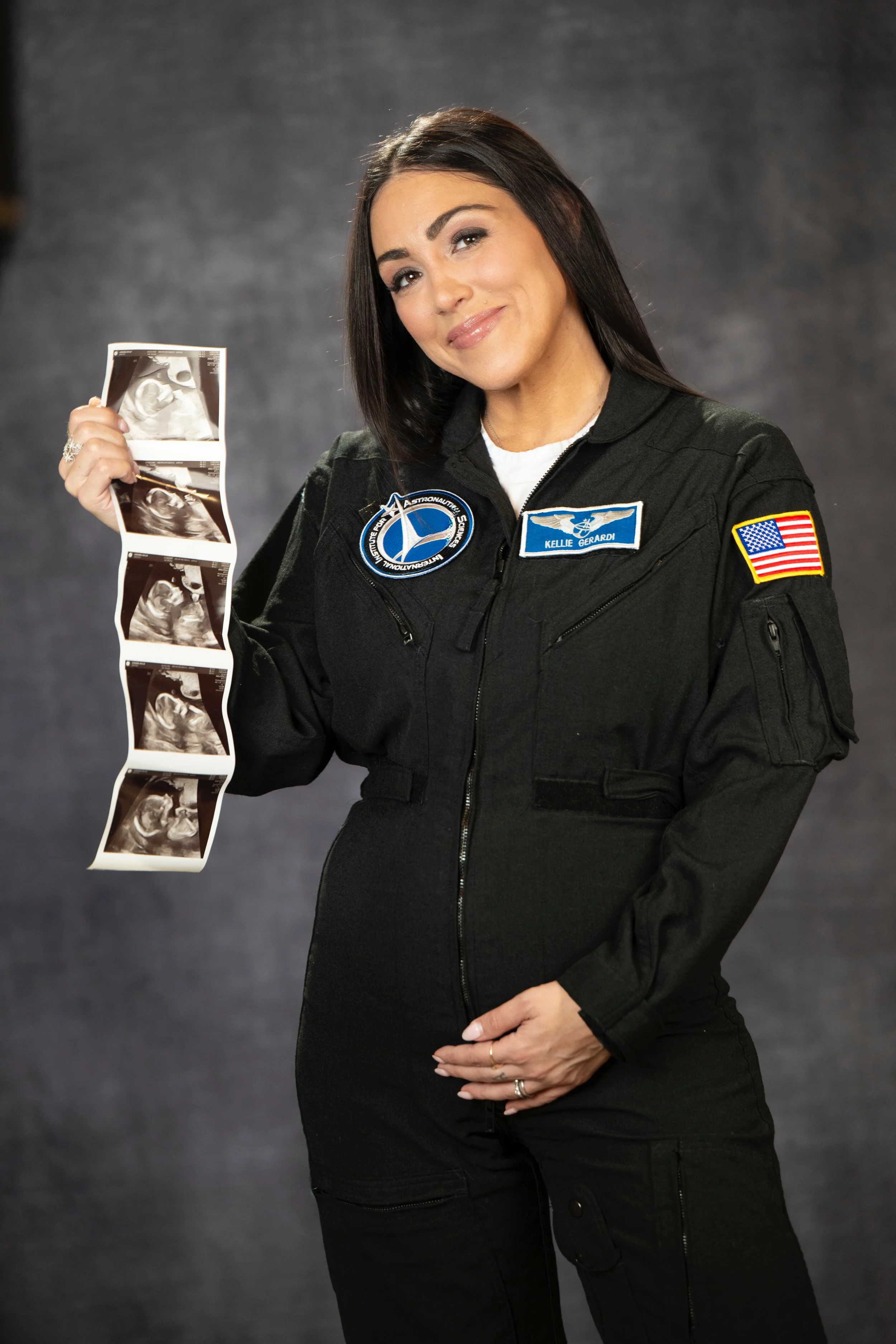
Kellie Gerardi occupies a rare intersection of these worlds. A research astronaut, scientist, and mother, she has also been open about her experience with secondary infertility and IVF, and about the quiet, often invisible emotional labor that accompanies prolonged uncertainty. Her perspective offers a way to think about the future of space not as an abstraction, but as a lived human experience shaped by resilience, vulnerability, and care.
What follows is an interview that explores these themes through Kellie’s lens. It is not a conversation about medical protocols or speculative technologies. Instead, it examines the emotional endurance required to pursue family-building under extreme conditions, and what those lessons might teach us as we imagine the first generations of humans born beyond Earth.
You’ve shared parts of your IVF and family-building journey very openly with 1.5 million followers online. Looking back, what feels most important for people to understand about the emotional side of that experience?
I’ve tried to use my platform to help explain that infertility and loss and IVF isn’t just a medical experience, it’s also an existential one. In many ways this journey can completely reshape how you experience time, hope, control, and even your relationship with your body.
For me, one of the hardest parts was the invisible undercurrent of it all. You can be in the lab, delivering a keynote, leading a research initiative, or smiling through a dinner party all while quietly carrying grief or painful uncertainty that feels almost too heavy to hold. There were so many moments when I felt like I was living two very different parallel lives, with one defined by extraordinary professional milestones that I was trying to honor, and another juxtaposed and defined by deeply private heartbreak.
That’s a large part of what motivated me to speak so publicly about my journey and share these most recent last few years of my journey transparently and in real-time. I think one big misconception I see in the comments is that I’m somehow exceptionally brave. Strength and fragility go hand-in-hand for me. Nothing about my experiences made me fearless, but I did become more practiced than I’d like at moving forward while afraid.
If sharing my journey has done anything, I hope it’s helped normalize conversations that too many women feel pressured to navigate in silence. I think silence can so often breed shame, and there is absolutely nothing shameful about wanting to build a family and fighting for that future.
Looking back, now about to welcome your second child after 8 years of secondary infertility, what was the hardest part of that journey emotionally and what surprised you about yourself along the way?
I think the hardest part for me has been learning to live inside prolonged uncertainty. For most of my life and career, the formula has always been the same: work harder, produce better outcomes. And then suddenly, for the first time in my life, family-building and IVF became this goal I couldn’t just “work harder” toward. Here was a situation where the outcome was out of my control no matter how much effort I applied.
I’m no stranger to acute pain and responding to a single moment of crisis, but I learned that infertility asks something completely different of you. It requires that you function, plan, and hope, while still holding the possibility that the future you imagined may not unfold the way you expected, or at all.
What honestly surprised me most was my own capacity for resilience, and not some dramatic, cinematic kind of resilience, but just a really quiet form of resilience that manifested in showing up to appointments and professional events when I’d rather be hiding from the world, or tweaking my protocol slightly and mentally re-committing to another round of IVF, or even just the resilience of allowing joy back in at all after loss.
“Strength and fragility go hand in hand for me.”
Were there any habits, mindsets, or sources of support that helped you get through the uncertainty and loss that can come with trying to build a family?
One of the most important mindset shifts I made was reminding myself that I can change protocols without changing the dream. Science is iterative, and eventually I realized hope could be too. A failed cycle did not necessarily mean a failed future; just like in my research career, I could learn to look at it as new data, a new approach, or another decision point.
I also became much more intentional about allowing myself to be supported. Independence is often applauded or celebrated, but I think there’s equally so much strength in letting people carry pieces of the weight with you. My family, my closest friends, my physicians, and my entire internet community formed a kind of scaffolding around me that held me steady when everything about my own footing felt uncertain.
And maybe most importantly, I prioritized self-compassion. There’s no perfect way to walk this road. Releasing the expectation that I had to navigate it flawlessly, especially in public, was also form of healing in itself.
As we imagine future families on Mars dealing with radiation, low gravity, isolation, and uncertainty in their everyday lives, what lessons from your own journey feel especially relevant?
Extreme environments don’t just test the body, they also test relationships, identity, and emotional endurance. One of the biggest lessons I’ve learned is that resilience isn’t about being “unbreakable”. It’s actually more about building the right support structures strong enough to hold you when you do break.
Beyond engineering solutions, future Martian settlers are going to need community architecture. They’ll need ritual, psychological safety, and human space for grief and frustration alongside progress. I think that even when surrounded by the most incredibly advanced technology humanity has ever built, the human heart will remain perfectly, beautifully analog.
And maybe this is a slightly unconventional take, but I also wonder if one of the greatest predictors of long-term survival off Earth will look more like emotional literacy than technical skills. The latter will be increasingly easily augmented as technology advances, but the former requires putting in the work. I think how we care for one another will matter just as much as how we build habitats.
What kinds of emotional or community support do you think will be non-negotiable for families trying to have children in extreme environments like Mars?
If humanity is serious about becoming multi-planetary, we have to stop thinking about survival as a purely technical problem. I think the concept of belonging itself will be a form of life-support system, and future settlements will need intentional community design (think spaces that foster connection, not just efficiency.) Mental health support will need to be normalized rather than just reactive, or worse, viewed as something that can be “screened out” of potential candidates from the start. Families will need to develop shared rituals that create continuity with either Earth or humanity broadly, to help anchor them in purpose and remind them that they are part of a much longer human story.
And maybe most importantly, vulnerability will need to be culturally permitted in a way that hasn’t yet existed in this industry. When people feel like they need to appear strong and invincible 100% of the time, the inevitable suffering becomes isolated and internalized. But if vulnerability is welcomed, resilience has the opportunity to become collective. In the same way Rome wasn’t built in a day, no one builds a Mars civilization alone!
“Resilience isn’t about being unbreakable. It’s about building support structures strong enough to hold you when you do break.”
So much of space culture is about toughness and endurance. How do you think we need to rethink what strength looks like when it comes to fertility, pregnancy, and parenthood, whether on Earth or Mars?
For a long time, strength and capability have been equated with stoicism in this field, with themes like pushing through, suppressing emotion, remaining unaffected. Even the phrase “the right stuff” evokes the image of the steely-eyed pioneer who almost appears more machine than human.
But fertility and parenthood force a completely different model. You can’t create a future on endurance alone, and if we really want sustainable human presence beyond Earth, we’re going to need to broaden our definition of strength to include emotional openness, adaptability, tenderness, attachment, and care.
I think that ultimately, the ability to nurture life might be one of humanity’s most sophisticated forms of resilience.
Despite how hard these journeys can be, what gives you hope when you think about the future of families, wherever humans end up living?
Hope, for me, lives in humanity’s relentless instinct to imagine the future. It’s kind of beautiful to realize that every single generation has approached and stepped into uncertainty believing life could expand beyond its current boundaries. That level of optimism is one of our defining traits as a species.
When I think about future families, whether on Earth or one day on Mars, I think about the universal human desire to protect, to love, to nurture, and to continue reaching forward towards the future. Choosing to bring a child into the world has always been a bold act of faith in that future, and I honestly can’t think of anything more hopeful.
You made a professional transition after your first spaceflight a few years ago when you stepped away from other work in national security and Palantir to focus fully on your leadership role with your research institute. What motivated that decision, and what excites you most about this chapter?
When my research institute sent me on my first spaceflight in 2023, I became the first female payload specialist to fly on a suborbital science mission, and it became increasingly clear that we are standing at the threshold of a new era where scientists are finally getting opportunities to fly and operate their own experiments in space. That’s shaping the future of space medicine in real time and I wanted to be fully present for that moment.
My dream has always been to help open up access to space for the next generation of scientists to use space as a laboratory to benefit humanity, and it was incredible that I had the opportunity to play such an active role in opening that door myself.
For the past few years in my role as Director of Human Spaceflight for the International Institute for Astronautical Sciences, I get to help expand access to microgravity and space for researchers around the world while contributing to the operational frameworks that will define the next generation of science missions. I’m also an Instructor and Flight Test Director for our microgravity courses and research campaigns, which has been helpful as I prepare to head back to space. Shortly after my first spaceflight, IIAS announced a follow-up dedicated science spaceflight, and I’m also tasked with leading that IIAS-02 mission, during which I have the privilege of flying alongside my colleagues Dr. Shawna Pandya of Canada and Dr. Norah Patten of Ireland. Between our crew and our research institute’s broader Space Medicine Group, we’ve been working toward several world-first studies designed to help close some long-standing research gaps, particularly in women’s health research. We genuinely can’t wait to share the publications.
And honestly, what excites me most is the multiplier effect of what we’re building. Every payload we fly, every researcher we support, and every dataset we generate is all compounding, and we have the opportunity to lay infrastructure not just for the next mission, but for future decades of discovery. Contributing to that kind of long-arc impact is the ultimate career dream.
Your academic path is also wonderfully interdisciplinary; starting with physics at Barnard in 2007, then a BA from NYU in documentary filmmaking with a science communication focus in 2011, then back to physics and science itself in 2015 with a Master of Science from Nova Southeastern University, along with post-graduate bioastronautics studies and an honorary Doctorate in Science and Technology for your pioneering work in microgravity research.
What did integrating a little bit of the arts alongside your science education teach you?
Intentionally integrating art into my science education fundamentally reshaped how I understand impact. Science generates the knowledge, but storytelling is what allows that knowledge to travel.
My science education grounded me in analytical rigor and taught me how to sit comfortably inside complexity. But an undergraduate foray into the arts with a focus on science communication taught me how to translate that complexity into narratives that resonate with people and they could actually connect with. If a breakthrough happens but no one understands why it matters, its potential is limited. And in an age that sometimes feels marked by decreasing scientific literacy, the ability to help translate science seems more valuable than ever.
Bringing that perspective into my Master of Science and my eventual work in bioastronautics helped me marry technical expertise and communication in a more integrated way. Receiving an honorary Doctorate in Science and Technology for contributions to my field of microgravity research was also deeply meaningful. During my commencement speech I spoke to both science graduates and arts graduates and shared the reflection that these disciplines are not opposites, they’re truly the inseparable yin and yang of human progress and innovation. Humanity’s next giant leap will require the talents of artists, engineers, and everyone in between. I have an immense appreciation for both, and I’m grateful I’ve never felt like I had to choose one box or label.
“Choosing to bring a child into the world has always been a bold act of faith in the future.”
When you imagine the first generation born beyond Earth, what do you hope is already different about the world that raised them?
I would hope they inherit a definition of belonging that’s way more expansive than the one we started with. Space has this unique and remarkable ability to remind us that borders are largely imaginary. When you see Earth as a shared, fragile planet, it becomes harder to justify the divisions that feel so entrenched on the ground.
My hope is that the first children born beyond Earth grow up with a planetary identity first, maybe seeing themselves not so much as citizens of a particular nation, but as participants in a shared human story. And more importantly, I hope that we’ve done the work here and now to build a future worthy of them.
Finally, when historians someday write about the earliest families who chose to build their lives off Earth, what quality do you think they’ll all share?
That’s a tough one! I think courage, for sure, but similar to our discussion earlier, I think it will be a quieter variety of courage, and one that’s grounded in hope. Every single generation that has crossed an ocean or forayed into the unknown has done so because they believed the future could be larger than the present.
Choosing to raise a child somewhere humanity has never lived before may ultimately be one of the most optimistic acts imaginable. It requires belief that our epic story continues and I find that incredibly beautiful. *