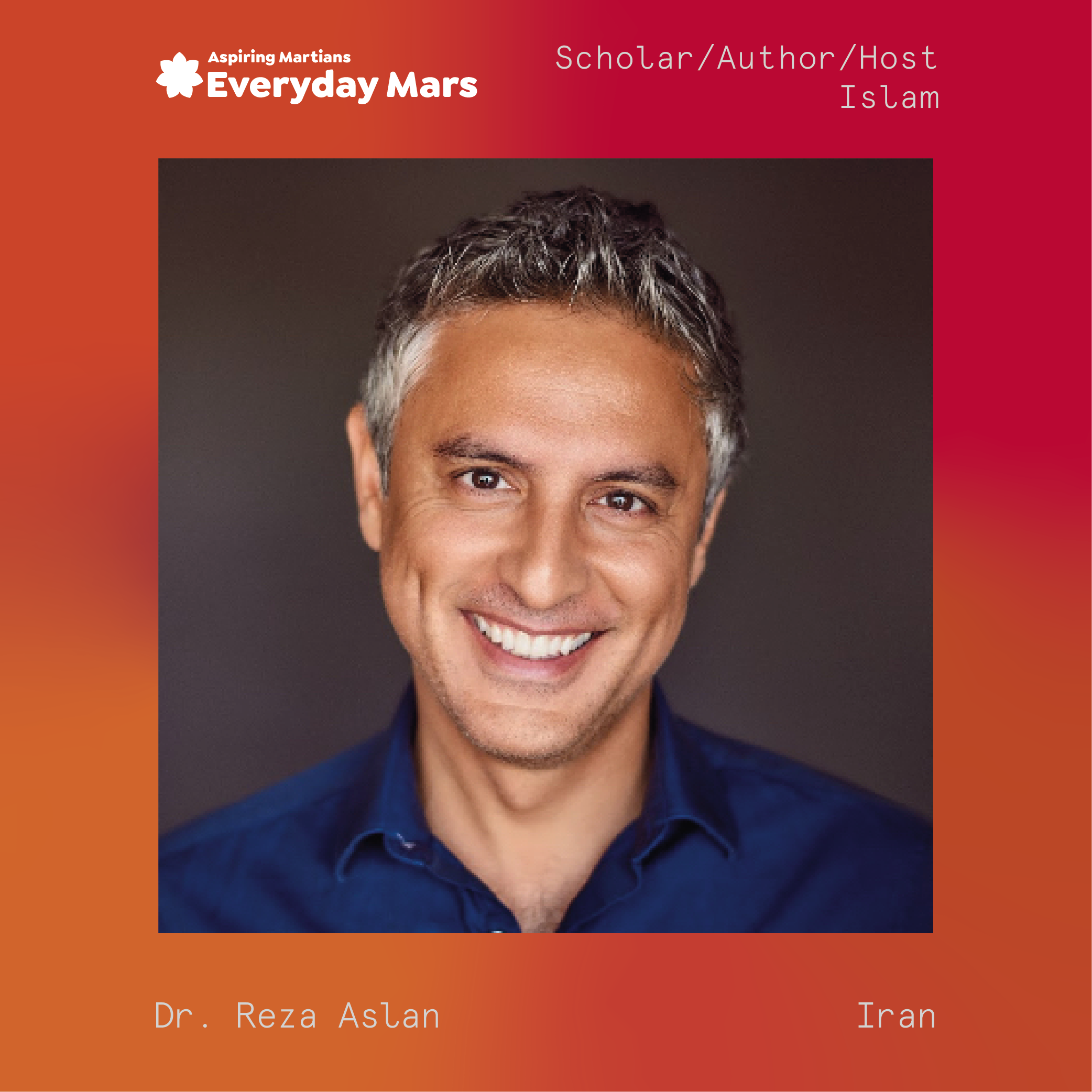
Islam on Mars with Reza Aslan
What happens to Islam when Earth is no longer beneath your feet?
This episode is the third installment in Aspiring Martians’ January series exploring Religion on Mars, following conversations on Buddhism and Hinduism, and leading into next week’s series finale on Christianity.
Joe is joined by Reza Aslan, a globally recognized scholar of religion, bestselling author, and public intellectual known for making complex religious history accessible and deeply human. Reza’s work focuses on Islam as a living tradition shaped by debate, migration, interpretation, and history rather than rigid doctrine.
In this conversation, Joe and Reza explore how Islam might function on Mars by first grounding the discussion in its origins: how Islam spread through trade, scholarship, and governance, and how its decentralized authority structure shapes religious decision-making today. They dive into the Five Pillars of Islam and examine how daily prayer, fasting during Ramadan, charity, pilgrimage, and belief itself might adapt on a planet with different days, directions, and environmental constraints.
The episode also explores Islam’s long relationship with astronomy, space, and scientific inquiry, including how Muslim scholars studied Mars centuries before modern telescopes, and how contemporary Muslim-majority nations are actively engaged in space exploration today. Along the way, they unpack why science fiction, especially Dune, draws so heavily from Islamic culture, language, and ideas of power, scarcity, and survival in harsh environments.
Rather than asking whether Islam can “work” on Mars, this episode reframes the question entirely: what does a faith built on adaptability, intention, and community already understand about living meaningfully in extreme places?
Featuring