What We Become on Mars
A review of Becoming Martian, with insights from our conversation with author Scott Solomon
27 March 2026
There is a particular kind of silence that follows liftoff.
Not the physical silence, because rockets are anything but quiet, but the conceptual one. The moment after the engines cut, after velocity is achieved, after the destination stops being theoretical and begins to take on weight. It is the silence of a question shifting without announcement, moving from “can we?” to something far less comfortable.
For decades, Mars has lived inside a familiar narrative. How do we get there? How do we land? How do we survive the first night? The language has been mechanical, grounded in propulsion systems and entry profiles, framed by timelines and mission architectures. It is a story told in hardware.
Becoming Martian begins where that story runs out of vocabulary.
Scott Solomon does not dismiss the engineering. He assumes it. And in doing so, he redirects the reader toward something far more consequential. If we succeed in settling Mars, the question is no longer about survival in the immediate sense. It becomes about persistence across generations. And persistence, as evolutionary biology makes clear, is never static.
We will not remain the same.
“Children born and raised on Mars would grow up with a fundamentally different sense of ‘home.’”
A Book That Refuses the Obvious
What makes Becoming Martian feel distinct is not just its premise, but its discipline. Solomon resists the gravitational pull of spectacle. He does not begin with Mars as a destination to be conquered. He begins with Earth as a system to be understood.
The opening passages, anchored in astronaut Scott Kelly’s experience, are not written to inspire awe in spaceflight. They are written to sharpen awareness of what we take for granted.
“The wind on your face. The smell of grass. The feeling of water—these simple pleasures become treasures you deeply miss in space.”
That sentence carries both a warning and an opportunity. Scott Kelly let’s the reader know that space, and eventually Mars, will lack aspects of daily life here on Earth that are deeply meaningful and yet often taken for granted. Those who will venture out into the final frontier will not have that unappreciated luxury; rather, they will find immense value in the subtleties.
From there, the book expands carefully. Solomon moves through Mars’s geological history, emphasizing that it was not always the barren world we see today. There were rivers, lakes, and conditions that may have supported life. The implication is subtle but important. Mars is not just hostile. It is the remnant of a world that lost its ability to sustain complexity.
That loss echoes forward. Every challenge humans face on Mars, from radiation exposure to atmospheric scarcity, is tied to that deeper planetary history. The book does not present these as obstacles to overcome, but as conditions to be lived within.
And living within them changes everything.
From Ants to Mars
Before Becoming Martian becomes a book about humanity, it is shaped by the trajectory of the person writing it.
Scott Solomon is an evolutionary biologist whose early work has very little to do with space and everything to do with how life adapts under constraint. His path into science began with a kind of curiosity that feels almost foundational. As a child, he was outside, digging, searching, imagining ancient worlds beneath his feet. That instinct carried forward into field research, including time in the Galápagos studying marine iguanas, and later into the Amazon Basin, where he focused on leafcutter ants.
Leafcutter ants are not simply insects collecting food. They are agriculturalists. They harvest leaves not to eat, but to cultivate fungus, which becomes their actual source of nutrition. It is a system that has persisted for millions of years, a tightly coupled relationship between organism and environment. Studying them requires patience, immersion, and a willingness to follow complexity wherever it leads.
When I asked Scott how he moved from that world to thinking about human evolution on Mars, he smiled in a way that felt both genuine and slightly amused, as though he recognized how improbable the connection sounded from the outside.
“It does seem like kind of a wild leap… But let me try to explain how that kind of played out for me.”
What followed was not a story about a leap, but about expansion. As a graduate student, he was writing research papers, contributing to a body of knowledge that, by design, reaches a limited audience.
“If things go well, those articles will be read by maybe a few dozen people… it’s a pretty small number of people.”
He did not frame this as a flaw in science, but as a limitation in reach. So he walked into a student newspaper and asked a simple question. Who is writing about science?
No one was.
So he did.
That moment pulled him into science communication, where the goal shifted from discovery alone to translation. From there, teaching became another extension of that same impulse. And in teaching, he encountered a question that would reshape his work.
“Do you think humans are still evolving? And if so, how?”
He described asking it in a classroom and watching the response unfold immediately. Students leaning in, talking, debating, engaging in a way that felt different from the rest of the material. It was not just a question about biology. It was a question about identity.
That moment became his first book, Future Humans: Inside the Science of Our Continuing Evolution. And at the very end of that book, almost as a speculative aside, he extended the idea outward. What happens if humans become isolated from Earth entirely?
He was quick to downplay its importance at the time. “That was kind of how I got to that thing… just an afterthought.”
But it was the part that stayed with readers. As Mars shifted from distant concept to active objective, that question returned with more urgency. What began as a footnote became the central thread of Becoming Martian.
Evolution, But Without the Drama
One of the book’s most effective contributions is how it re-centers evolution as something ongoing and immediate. Popular narratives tend to frame evolution as dramatic and slow, tied to extreme environments or long stretches of time. Solomon dismantles that framing with precision.
When I pushed on this idea, suggesting that modern life might insulate us from evolutionary change, he responded with a clarity that felt almost corrective, though never dismissive.
“If that trait gets more common or less common from one generation to the next, that’s evolution.”
That definition removes the drama entirely. Evolution becomes a process of accumulation. Small changes, generation by generation, shaped by selection, randomness, and mutation.
“Even within a few generations, difference could begin to emerge.”
On Earth, these processes are moderated by scale and connectivity. Large populations and constant gene flow dilute extremes. On Mars, those moderating forces are reduced. A small founding population carries only a subset of human genetic diversity. Genetic drift becomes more pronounced. Mutation continues as a constant source of variation.
Mars does not need to accelerate evolution.
It only needs to remove the buffers that have been holding it in check.
The Forces That Will Shape Us
One of the most compelling aspects of Becoming Martian is how deliberately Scott resists the temptation to jump straight to outcomes. He does not begin by asking what future Martians will look like. He begins by asking what forces will act on them over time.
It is a subtle but important distinction, and when we talked about it, you could feel how central that framing is to the way he thinks. He kept returning to the same idea, not as a dramatic statement, but as a kind of grounding principle.
“Any organism that is isolated on an island for a long amount of time will almost inevitably evolve into a new species.”
Mars, in this context, is not just another environment. It is an isolated system with a very specific set of pressures, and those pressures will shape evolution whether we intend them to or not.
The first and most obvious force is gravity. Mars has roughly one third of Earth’s gravity, which means every aspect of the human body that evolved under Earth’s pull will begin to recalibrate. Bones will not need to be as dense to support weight. Muscles will not need to generate as much force to enable movement. Over generations, this creates a directional pressure toward bodies that are lighter, more elongated, and less robust in ways that would make them poorly suited for Earth.
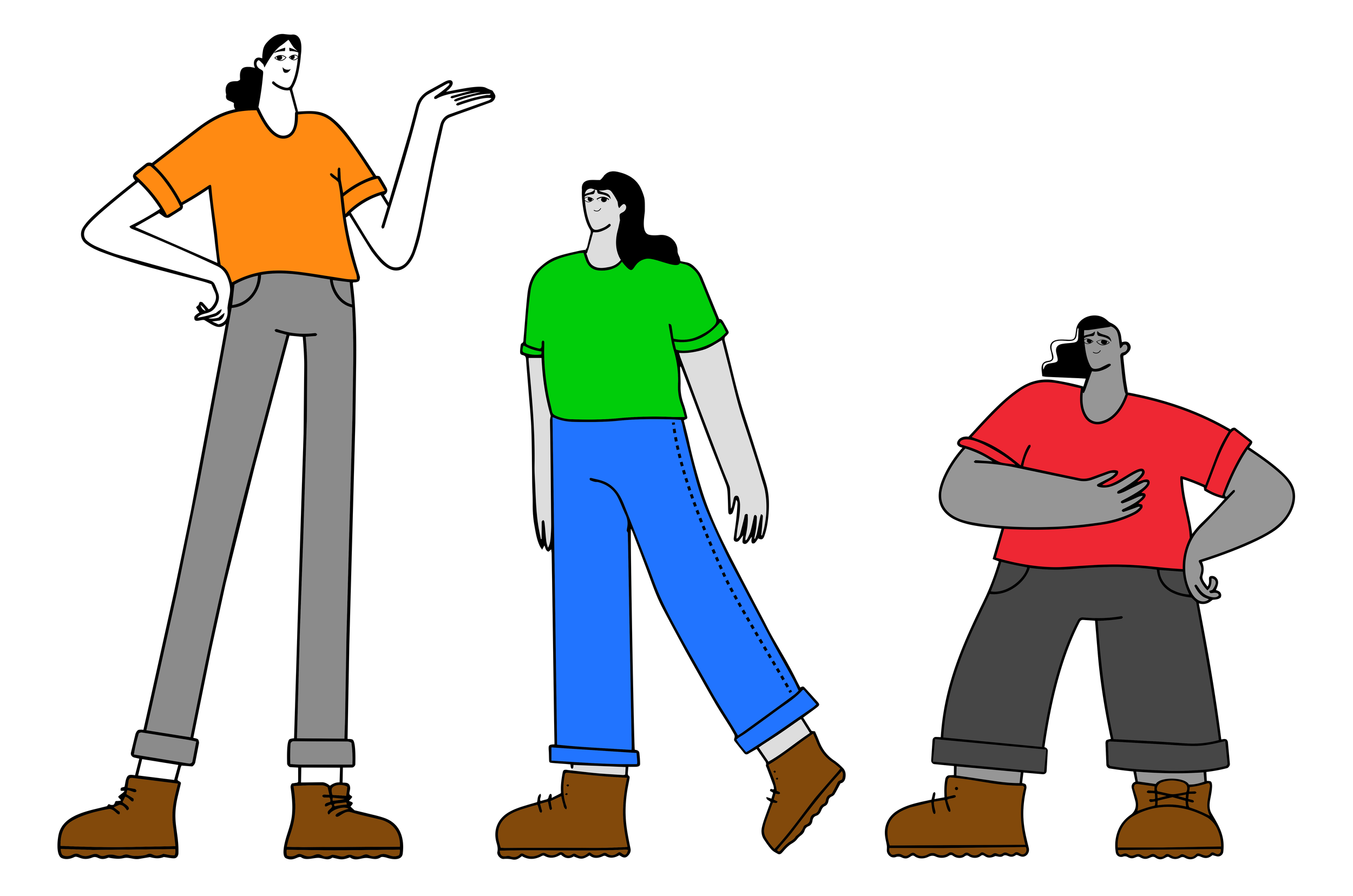
A comparison of how future Martians might physically evolve. On the left, a common depiction shows a tall, thin, pale figure shaped by lower gravity and reduced sunlight, standing beside an average Earth human in the center. On the right, an alternative vision based on Scott Solomon’s research suggests future Martians may instead be shorter and more stocky, with denser bones to support long-term survival and darker skin to help protect against increased radiation exposure.
But gravity alone does not tell the full story, and this is where Solomon’s reasoning becomes more interesting. Evolution is never shaped by a single factor. It is the result of competing constraints, and on Mars, those constraints do not all point in the same direction.
Radiation is another major force, one that operates more invisibly but with potentially greater long-term consequences. Without a thick atmosphere or a global magnetic field, Mars exposes its surface to higher levels of cosmic radiation. This increases mutation rates, which introduces more genetic variation into the population. Some of those mutations will be harmful. Some may be neutral. A few may provide advantages in ways we cannot fully predict. Over time, radiation becomes not just a hazard, but a driver of change.
Then there is population size. Early Martian settlements will almost certainly be small, which means genetic drift will play a much larger role than it does on Earth. Traits can become more or less common not because they are advantageous, but simply by chance. When Scott talked about this, he did not frame it as an edge case. He framed it as inevitable.
“If that trait gets more common or less common from one generation to the next, that’s evolution.”
There was something about the way he said it that made the randomness feel less like noise and more like a defining feature. On Mars, chance will matter more.
And then there are the constraints that do not immediately come to mind but may prove to be the most influential. Reproduction, for example, becomes a central pressure point. The human body is already operating near its limits when it comes to childbirth. Changes in bone density, pelvic structure, and fetal development will all interact in ways that shape which traits persist.
This is where the common image of future Martians begins to break down. It is easy to imagine tall, slender humans drifting lightly through low gravity, but Solomon complicates that picture. Bones cannot simply become weaker without consequence. A body that cannot successfully reproduce does not pass on its traits. That introduces a counter-pressure toward strength and resilience in very specific areas, particularly in skeletal structure.
The result is not a single, clean direction of change, but a balancing act. Taller frames may emerge due to reduced gravitational compression, but they may be paired with denser bone structures than we would expect. Limbs may lengthen, but joints may need to adapt to different stress patterns. Skin may evolve increased pigmentation or other protective mechanisms in response to radiation exposure. Circulatory systems may adjust to different fluid distributions in lower gravity environments.
Over time, these changes compound.
What emerges is not a dramatic transformation overnight, but a gradual divergence. A population that still looks recognizably human, but with proportions, resilience, and vulnerabilities shaped by a world that operates under different rules.
And perhaps the most important point Solomon makes, both in the book and in conversation, is that none of this requires intention. It does not require design.
It only requires time, isolation, and persistence.
Mars will not ask what we want to become.
It will shape us through what it allows.
The Microbial Boundary
What if we told you that the moment humans set foot on Mars someday in the future, they won’t be alone? Sounds like the plot to many sci-fi thrillers that usually end up badly for the unsuspecting astronauts. The twist in this story is twofold: this will 100% be real…and we will be the ones bringing the “others” with us.
Because the moment humans arrive, it won’t be empty anymore. Not really. It will be filled with something far more consequential than structures or machinery. It will be filled with life we can’t see.
Ours.
Not just our bodies, but the trillions of microorganisms that live inside them, on them, and around them. The quiet ecosystem we carry everywhere without noticing. The one that, on Earth, we never have to think about because it is always there, always replenished, always balanced by the wider world.
“Many of the organisms we depend on are invisible to us.”
Mars breaks that balance immediately. What we bring is all we get.
Scott didn’t rush this point when we talked about it. If anything, he slowed down, like he wanted to make sure it landed properly. Because it’s easy to treat microbes as background noise. Something technical. Something distant from the human story.
The version of us that survives on Mars will not just be shaped by gravity or radiation. It will be shaped by which microbes make the trip, which ones survive, and which ones disappear entirely. That ecosystem will drift. It has to. Closed environments always do.
And then, over time, it becomes the baseline. A Martian-born child won’t be missing something. They’ll just be calibrated differently.
Different immune responses. Different tolerances. A different internal definition of what “healthy” looks like.
Which leads to a question that feels almost unfair once you realize what it’s asking. What happens if they come back?
Scott didn’t hesitate.
“That could be very dangerous to future Martians.”
What makes this dangerous is not just that the two environments are different.
It’s that they will stop sharing a common biological baseline.
On Earth, our immune systems are constantly being trained through exposure to a vast diversity of microbes. That exposure teaches the body what to tolerate and what to fight. Mars interrupts that process entirely.
A Martian settlement will be controlled by design. Air filtered. Water recycled. Surfaces sterilized. The microbial world there won’t be abundant and varied like Earth’s—it will be limited, curated, and over time, fundamentally different. A child born on Mars won’t just grow up in a new environment. They’ll develop an immune system calibrated to a completely different microbial reality.
And that difference cuts both ways.
The microbial ecosystem on Mars will evolve alongside its human population, diverging from Earth’s with each generation. So when someone moves between the two worlds, they aren’t just traveling; they’re carrying an entire ecosystem with them.
For a Martian returning to Earth, that could mean exposure to microbes their body has never learned to handle. For an Earth-born human going to Mars, it could mean introducing new microbes into a closed environment that has no natural way to absorb or regulate them.
And unlike Earth, Mars has no buffer. No wider biosphere to rebalance what gets disrupted. Everything is contained. Which means the challenge of moving between Earth and Mars may not just be about distance or technology.
It may be about compatibility.
Intervention and Responsibility
Eventually, the conversation in the book takes a turn to something that would make many people feel uncomfortable, but takes on a whole new perspective in the context of Mars.
Up until this point, you can read Becoming Martian as observation. As explanation. A careful unfolding of what will happen if we place humans in an environment like Mars and let biology take its course.
But eventually, that framing breaks. Because we are not passive participants in our own evolution anymore.
We have tools now. Real ones. Not speculative, not theoretical. Gene editing exists. It is imperfect, still developing, but undeniably real. And for the first time in our history, we are not just subject to evolution.
We can influence it.
The question now becomes what we do with that.
“For the first time in our history, we may have the ability to influence our own evolution in a directed way.”
When I asked Scott about this, he didn’t jump to an answer. There was a pause, not long, but noticeable. The kind of pause that signals he’s not just recalling information, but actively weighing it.
Then, he carefully says, “Perhaps it’s unethical not to do that.”
That word “perhaps” does a lot of work.
Because without it, the statement would land as a conclusion. Clean. Assertive. Almost clinical. With it, something shifts. It opens the idea instead of closing it. It signals that this isn’t settled ground, even for him. It invites you to sit with the weight of it, to feel where it pulls, rather than simply agree or disagree and move on.
And the more you sit with it, the harder it becomes to ignore what it’s really asking.
On Mars, the environment is not neutral. It is not something we simply adapt to over time in a passive sense. It is actively working against us in ways that are both predictable and relentless. Radiation is not an occasional hazard. It is constant, quietly damaging DNA with every exposure. Low gravity does not just feel different. It reshapes the body over time, weakening bones, altering circulation, changing the way we physically exist. Isolation does not just affect psychology. It compounds every vulnerability, because there is no external system to absorb failure.
So the question starts to sharpen. What does responsibility look like in an environment like that? If we have the ability to reduce those effects, to engineer resistance to radiation, to reinforce bone density, to preempt the biological costs of living on Mars, is choosing not to act a form of restraint or a form of neglect?
And at the same time, where is the boundary?
Because the moment we move from treating illness to redesigning baseline human traits, the conversation changes. It stops being about survival in the immediate sense and starts becoming something closer to authorship. Not just adapting to Mars, but deciding, intentionally, what kind of humans are best suited for it.
That is not a technical question. It’s a philosophical one. And what Becoming Martian does so effectively is refuse to simplify it. It doesn’t frame intervention as progress or avoidance as virtue. It holds both possibilities in tension, letting them exist side by side without forcing resolution.
Which is why the question lingers. Because Mars won’t just test our ability to survive somewhere new. It will test how we define survival in the first place.
And how far we’re willing to go to achieve it.
The Slow Drift of Identity
The biological changes are easier to track because they follow rules we already understand. You can measure them, model them, and even begin to predict their direction, even if the exact outcome remains uncertain. Identity doesn’t work that way. It doesn’t arrive all at once or announce itself as something new. It builds slowly, almost imperceptibly, shaped by experience until, at some point, it simply feels obvious in retrospect.
“It wouldn’t just be an extension of Earth. It would become something new.”
A child born on Mars will grow up in a world that makes complete sense to them. That’s the part that’s easy to miss. Mars won’t feel hostile in the way it feels to us. It will feel structured, familiar, even predictable. The risks will exist, but they’ll be part of the background, not something constantly questioned or re-evaluated. They’ll be conditions, not obstacles.
Earth, by contrast, will occupy a very different space in their understanding. It will be something they learn about rather than something they know. A place they’ve studied, seen in images, heard described in detail, but never actually lived. And that distinction, subtle at first, begins to carry more weight over time. Because lived experience, more than anything else, is what anchors identity.
When Scott talked about this, his tone shifted slightly. It moved away from analysis and into something more reflective, like he was stepping out of the framework of biology and into the reality of what that divergence might feel like.
“If we can’t interact… that would logically lead us toward a situation in which each planet sort of evolves separately.”
There’s no drama in the way he says it. Just a kind of quiet logic that makes the outcome feel less like a possibility and more like a process already in motion.
Because this isn’t a sudden break. There’s no moment where Earth and Mars consciously separate or decide to become something different. It happens gradually, through culture, through experience, through the accumulation of small differences that eventually stop feeling small.
And at some point, the distance between the two is no longer defined by miles or minutes of light delay. It’s defined by perspective.
At that point, the question isn’t whether Martians will feel different.
It’s whether they will feel like they were ever from Earth at all.
Signal Received
There is a version of this story that ends in separation. Earth and Mars becoming distinct, not just geographically, but biologically and culturally. Two branches of humanity moving forward on different paths.
Becoming Martian does not deny that future. But it also offers another way to look at it. Not as a fracture, but as a continuation.
The same forces that have always shaped humanity, migration, isolation, adaptation, are now being applied at a new scale. Mars is not breaking the human story. It is extending it.
The optimism here is not about staying the same. It is about remaining connected to the process that has always defined us.
We adapt. We persist. We move forward into environments that do not fit us, and we find ways to belong anyway.
Mars will change us. But that has always been true of every place we have ever gone. And whatever we become there will not be something entirely new.
It will be something that began here. *
Adapted in part from Joe Sweeney’s interview with Dr. Scott Solomon for the Aspiring Martians: Everyday Mars episode "Becoming Martian" on 17 February 2026.