This Was Never an Edge Case. Period.
What space systems still need to learn about menstruation.
10 April 2026
There is a particular kind of progress story we like to tell about spaceflight. It is clean, metallic, dramatic. Rockets rise. Capsules splash down. Engineers solve impossible problems with checklists and grit. The future arrives wrapped in heat shields and mission patches, and when it does, it seems to promise that humanity has finally outgrown its old limitations.
And then a subject like menstruation enters the room and reveals how selective that story has always been.
Because if we are honest, one of the strangest things about our species preparing to live on Mars is not that we still do not know how to build perfect habitats or grow food at scale in Martian regolith or protect human tissue from deep-space radiation. It is that after more than sixty years of human spaceflight, we still have alarmingly little data about something that happens to hundreds of millions of people every day on Earth. We have designed spacecraft for urine, sweat, tears, vomit, carbon dioxide, bone loss, muscle atrophy, circadian disruption, isolation, and fear. But menstruation has often remained in a category of its own: acknowledged, sometimes managed, rarely centered.
That was the heart of my conversation with Manju Bangalore, though the deeper truth is that she does not really allow the conversation to stay at the level of omission for very long. She pushes it toward something more uncomfortable and more useful. Not just what we have failed to study, but what those failures say about who we imagine space is for. Not just whether people can menstruate in orbit, but whether future space systems will treat menstruating bodies as normal human bodies rather than as logistical complications. Not just whether there will be period products on Mars, but whether dignity, autonomy, and care will be designed into the settlement from the beginning.
“If we’re serious about becoming a spacefaring species, this isn’t an edge case, it’s a design requirement.”
From Pain to Movement
Manju knows how to move between these scales because her life already does. She is, as her own introduction makes clear, difficult to summarize in a single breath: “I am a physicist, an astronautical engineer who has worked at two NASA centers, one of which being Johnson Space Center, where I worked in the astronaut office on the cockpit displays of the Orion spacecraft.” She also worked in the Obama White House on science policy. In parallel, at age seventeen, she founded Operation Period, the nonprofit that has now distributed more than 300,000 menstrual products and evolved from direct service into a broader fight for what she calls “menstrual freedom.”
That phrase matters. It is more expansive than menstrual equity, and more ambitious. Equity, as Manju describes it, is essential, but incomplete. It is “the floor, not the ceiling.” Freedom asks harder questions. Why were people denied access in the first place? Which structures made basic care inaccessible? Which social rules taught people to feel shame about their own biology? Who profits from silence, and who gets left out when systems are built around a narrow idea of the normal human body?
Those questions did not begin for her in a laboratory or a policy memo. They began with pain. She told me that she started Operation Period in February 2015 while having “a really painful period,” aware at once of her own discomfort and of the fact that she still had access to products, medication, heat, and shelter. There were others, she realized, only miles away, experiencing the same biology without any of those supports. Then came a moment in a checkout line. The woman in front of her was buying menstrual products; her card was declined. Manju paid for both sets of supplies, and the experience crystallized into obligation. “I think this is the universe telling me that this is something I need to do.”
Stigma That Scales With Us
From there, the problem widened. Product distribution was necessary. Education was necessary. But the more she learned, the more obvious it became that lack of supplies was only one visible symptom of a much larger system of neglect. Menstrual stigma had not merely made things awkward. It had shaped funding, policy, product design, research priorities, and public imagination. Even now, Manju noted, “there is not one dedicated menstrual health funder in the US.” Work in this space has to be translated into something adjacent and more culturally legible, whether that means women in STEM, student wellbeing, or poverty alleviation. Menstruation itself still struggles to be treated as a primary issue.
That same dynamic follows us into space.
For all the futurist language around becoming a multiplanetary species, spaceflight still carries older assumptions about which bodies are standard and which bodies create extra work. Menstruation becomes a problem not because the body is malfunctioning, but because the surrounding systems were not designed with it in mind. Manju put it plainly: “I don’t think these space systems that we’re designing should force us into like one biological pathway. Like we should have the ability to decide when and if we want to menstruate.”
“Equity was the floor, not the ceiling.”
That sentence lands harder the longer you sit with it. Because what sounds like a conversation about preference is actually a conversation about autonomy under constraint. Historically, many astronauts who menstruate have suppressed their cycles during missions using hormonal contraception. On the surface, that can look like practical convenience. In reality, the choice is shaped by the architecture around it.
If waste systems are not optimized for menstrual waste, if cleaning reusable products is difficult, if supply chains are tight, if the social environment still treats periods as a complication, then “choice” starts to blur. She caught herself mid-thought during our conversation after using that very word. “I say chosen and I think that’s interesting that I just said that word because I don’t know how much of a choice it’s been often.”
This is where the conversation becomes more than symbolic. It becomes engineering.
What We Don’t Know (Yet)
We know some basic things. Menstruation can happen in space. It is not dependent on gravity to the degree popular imagination might suggest. Uterine contractions still occur. Short-duration data suggest that it is safe to menstruate in orbit. But beyond that, the gaps remain astonishing. What products work best in microgravity? How many are actually needed? How does flow behave? What does adhesion look like? Does microgravity alter retrograde flow risk? How should habitats handle disposal, cleaning, reuse, diagnosis, pain management, and nutrient loss over long missions?
These are not obscure questions. They are the kinds of questions that become critical the moment you stop treating Mars as a flag-and-footprints stunt and start imagining it as a place where people will actually live.
And yet our cultural memory of menstruation in space is still dominated by the most famous anecdote of all: Sally Ride and the hundred tampons.
Manju was careful with the story, which is worth being careful with because the myth has grown larger than the facts. NASA did not fly one hundred tampons for Ride’s week-long mission. But the question was asked during planning, and the question itself has endured because it captures a whole era of institutional cluelessness in a single image. Men trying to estimate a woman’s bodily needs without enough understanding to realize they are off by an order of magnitude. It is funny because it is absurd. It is also revealing because it shows how little the world’s most advanced space agency understood about the biology of the people it had begun sending off-world.
But she added a layer that usually gets lost in the retelling. Spaceflight is a world of severe mass and volume constraints. Every item must justify its existence. Safety margins matter, but so does precision. That is exactly why robust menstrual research matters. Not to dramatize menstruation as a special problem, but to make the system less wasteful, less improvisational, and more humane. “Spaceflight requires precision of us,” she said. “And so that is why Redshift Lab is pursuing quantitative data for periods in space.”
The Hidden Complexity of “Normal”
Redshift Lab is the research arm Manju launched under Operation Period after a parabolic flight experiment on menstrual blood in microgravity helped the issue break into public view. She described posting about the experiment on the flight home without much planning, only to watch it explode online, drawing roughly 25 million views across Instagram and TikTok. What that reaction suggested was not just curiosity, but hunger. People cared. The stigma, once named aloud, suddenly looked flimsy.
Still, public attention is not the same as scientific depth. One of the most disquieting facts to emerge in our conversation was how recently menstrual blood itself began to be treated as worthy of direct scientific study. We are only just beginning to understand how real menstrual blood behaves compared to synthetic stand-ins long used in research. That matters because if you are trying to model flow, clotting, absorbency, or product performance in altered gravity, the fluid itself cannot be an afterthought.
The oversight becomes even more striking when you widen the lens beyond a “typical” cycle. The word menstruation can sound deceptively singular, as if it names one stable experience. But many people menstruate through severe pain, heavy bleeding, PMDD, endometriosis, PCOS, and a long history of being minimized by medicine. That, too, will come to Mars with us.
“I say chosen… and I think that’s interesting that I just said that word because I don’t know how much of a choice it’s been often.”
Manju was especially forceful here. She spoke about heavy menstrual bleeding, which affects large numbers of menstruators, and about the urgent need to model not only nominal flow but non-nominal cases in space environments. She spoke about endometriosis not as a niche issue, but as a profound example of how badly clinical systems have failed. Patients have been “screaming this for so long,” she said, only to be dismissed, delayed, or misdiagnosed. The average diagnostic journey can stretch for years. In some cases, the disease spreads well beyond the reproductive organs. It can become a whole-body experience of pain, fatigue, inflammation, and disbelief.
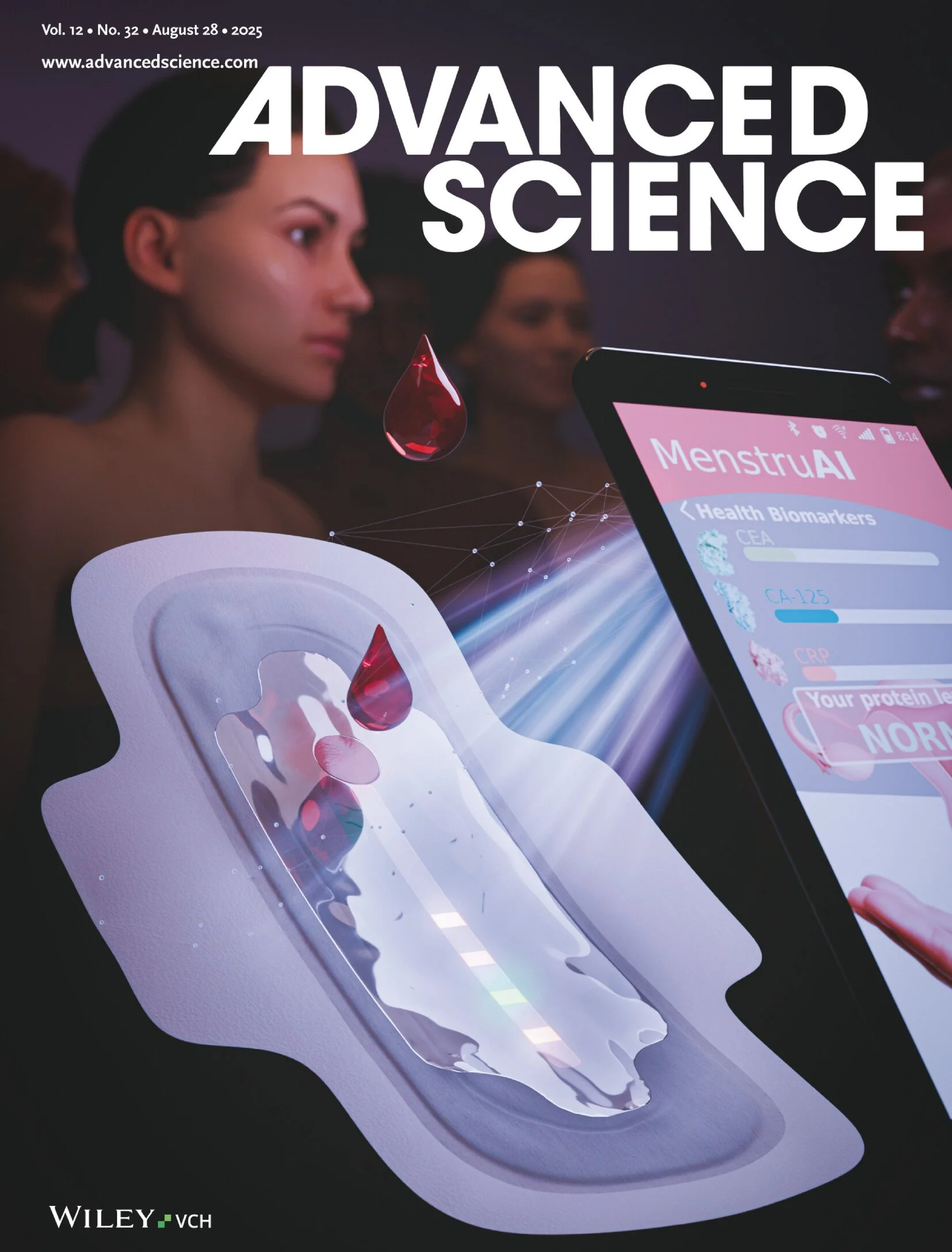
MenstruAI, a next-generation diagnostic concept, embeds biomarker-detecting sensors into menstrual products, transforming monthly cycles into real-time health insights.
And yet here, too, there is possibility. Some of the most compelling future-facing technology Manju described does not involve rockets at all. It involves pads with sensors, menstrual blood as diagnostic data, and the prospect of detecting biomarkers for conditions like endometriosis in minutes rather than years. Researchers are beginning to treat menstrual blood not as waste, but as a recurring biological dataset; one that reflects inflammation, hormonal shifts, and disease markers in real time.
Projects like MenstruAI, currently being developed in Europe, are embedding test strips directly into menstrual products to detect multiple biomarkers at once, pairing them with apps that can interpret results almost instantly. At the same time, researchers in the United States are working on identifying proteins like HMGB1 in menstrual blood, which are strongly associated with endometriosis, using tools that function similarly to rapid diagnostic tests. The implication is difficult to ignore: what has historically been dismissed or hidden may actually be one of the most accessible and underutilized sources of health data in the human body.
The shift here is not just technological, it is conceptual. For decades, diagnosing conditions like endometriosis has required years of symptoms, dismissal, and often invasive procedures to confirm what patients already knew. Now, the possibility exists that answers could emerge from something that happens every month, without additional burden, without delay. And when viewed through the lens of Mars, the stakes become even clearer. In an environment where medical intervention is limited and early detection is critical, these kinds of diagnostic tools are not conveniences, they are necessities. But their impact will not be confined to space. The same systems that could help astronauts monitor their health millions of miles from Earth could radically reshape care here at home, reducing diagnostic timelines, increasing access, and reframing menstruation not as something to manage quietly, but as something worth understanding.
That question resonates far beyond reproductive health. It is also a pattern in exploration. Again and again, human beings have mislabeled things as incidental because they did not fit the dominant story being told about what matters.
Space history has its own version of this blind spot. There has always been a tendency to imagine that the human future beyond Earth will be engineered around dramatic firsts: the first habitat, the first greenhouse, the first child, the first grave. But civilization is not actually built from firsts. It is built from recurrence. Daily maintenance. Bodily rhythms. Minor discomforts that become major if neglected. The reality that a crewed Mars mission will not be populated by abstract astronauts but by specific humans with hormones, needs, private routines, vulnerabilities, and limits.
Which is why period pain, in our conversation, felt like such a revealing threshold.
Manju made the point sharply: we are willing to discuss childbirth on Mars because it sounds grand and species-defining. We are less willing to take ordinary menstrual pain with the same seriousness, as if the spectacular form of reproductive biology deserves engineering attention while the recurring one can be sidestepped with suppression. “When we consider so many other health concerns for spaceflight, we as menstruators deserve that same kind of care and time,” she said.
The practical challenge is real. Deep-space missions complicate medication stability, resupply, and risk management. Hormonal suppression itself raises questions, especially in an environment already associated with altered fluid distribution and clotting concerns. She noted that oral contraceptive use may become riskier in space, especially when layered onto a system already physically transformed by microgravity. Meanwhile, letting periods happen in a system not built for them can create its own cascade of problems. This is not a tidy tradeoff between convenience and inconvenience. It is a systems design challenge with medical, ethical, and operational dimensions all tangled together.
Old Knowledge, New Worlds
And like so many such challenges, it may not be solved by one sleek technological answer. One of the most refreshing parts of our conversation was the ease with which she moved between advanced aerospace research and much older forms of embodied knowledge. Ginger. Chamomile. Turmeric. Heat. Movement. The possibility that some of the most useful tools for future Martian healthcare may not all come from futuristic packaging, but from a more holistic understanding of how bodies have long coped with pain under constrained conditions.
There was something quietly beautiful in that thought. A Martian outpost where someone grows ginger not only for flavor or nutrition, but because it helps with cramps. A place where care is not reduced to pharmaceuticals shipped from Earth, but expanded to include cultivation, ritual, habit, and practical wisdom inherited across generations. It is easy to romanticize that image, of course. Mars will not make pain poetic. But it may force us to rediscover that good design often begins by respecting both technology and lived experience.
The same is true of waste.
“It can’t be an afterthought. It needs to be central to our design process.”
Closed-loop thinking is one of the defining logics of off-world settlement. Air must be recycled. Water must be recycled. Nutrients must circulate. Waste, in such a system, is never just waste. Manju wants menstruation brought into that logic not as an embarrassment to be hidden, but as “this engineering input with closed loop systems.” That phrase alone is a quiet revolution. Menstrual blood, in this framing, stops being a contaminant narrative and becomes part of the habitat conversation.
She pointed toward reusable products as one promising avenue once a crew is actually on Mars, where water recycling systems and sterile wash processes could make reuse more feasible than in transit. She also pointed toward the possibility, already explored in simulated Mars contexts, that menstrual blood could support plant growth as part of a larger nutrient cycle. The symbolism matters here as much as the science. Menstrual blood has so often been treated as something dirty, degrading, or socially contaminating. To imagine it helping sustain life in a Martian greenhouse is to overturn centuries of inherited disgust in a single gesture.
She sees that clearly, and she does not separate it from dignity. The point is not to instrumentalize menstruation in a new way, reducing it to fertilizer or diagnostics. It is to build systems in which care, sustainability, and respect do not have to compete. “What does it look like to reclaim this menstrual blood that has been taboo, that has been stigmatized, that has made us feel less than?” she asked. The question carries Earth inside it. Mars simply makes the stakes impossible to ignore.
That may be the deepest value of this whole discussion. Space, in Manju’s telling, is not a distraction from earthly injustice. It is a focusing device. It reveals what has always been there.
On Earth, menstrual injustice is often treated as peripheral, someone else’s issue, a problem of poverty elsewhere, a matter for private management rather than public concern. But her work refuses that distancing. She reminded me that 20 percent of menstruating American students have missed school because of their period. She spoke of incarcerated menstruators receiving shockingly inadequate supplies. She spoke of the teenager in Kenya who died by suicide after being shamed for menstruating at school. These are not edge cases. They are what stigma looks like when it enters institutions.
The reason storytelling matters so much to her is that facts alone do not always break those structures open. “I think stories are so important,” she said. “I think it’s important that we don’t forget the actual humans and the names behind these stories.” Statistics can establish scale. Stories establish moral presence. They return bodies to the frame.
That is true for advocacy, and it is true for Mars.
We can speak in broad strategic terms about human settlement, long-duration missions, reproductive health, or mission architecture. But eventually the future becomes one person at a time. One astronaut wondering whether her pain relief still works after months in radiation. One crew member trying to decide whether suppression still feels like a choice. One young person on Earth listening to a conversation like this and realizing, maybe for the first time, that her body belongs in the future too.
That is why Manju’s work feels so important. Not because it is niche, but because it exposes how easily huge systems are built around unspoken exclusions. Menstruation on Mars is not really a story about periods as a special category. It is a story about whether we are capable of designing an off-world civilization that begins from the full truth of being human.
Signal Received
We can speak in broad strategic terms about human settlement, long-duration missions, or mission architecture. But eventually the future becomes one person at a time. One astronaut wondering whether her pain relief still works after months in radiation. One crew member deciding whether suppression still feels like a choice. One young person on Earth realizing, maybe for the first time, that her body belongs in the future too.
That is where this discussion resolves. Not in a lab or a policy document, but in a simple recognition: the future we are building is only as complete as the bodies we choose to include.
What Manju Bangalore’s work makes clear is that menstruation is not a niche variable. It is a recurring, predictable part of human life that has simply been left out of our design priorities. And when something so fundamental is excluded, the systems built around it inherit that gap.
Mars does not create that problem. It exposes it.
On Earth, we can get by with partial solutions. Stigma can remain invisible because the system still works for some. But Mars offers no such luxury. Every assumption must be made explicit. Every biological reality must be accounted for. There is no room for pretending that a recurring human need is optional.
That is what makes menstruation such a powerful lens into the future of space. If we cannot design for something this universal, then what else are we overlooking?
And who?
Because beneath the biology is a deeper question of belonging. Whether the systems we build beyond Earth will quietly inherit the same blind spots about whose needs are standard and whose are negotiable.
Bangalore’s idea of menstrual freedom reframes that entirely. It asks us to move from access to agency, from accommodation to inclusion. Not solving for a problem, but designing for a person.
And the impact does not stop at Mars.
The same constraints that force better design in space can reshape life on Earth. Closed-loop systems become better sanitation. Limited resupply becomes smarter distribution. Long-duration care becomes faster diagnostics. And simply naming menstruation as part of system design helps dismantle the stigma that has kept it hidden.
A first-time menstruator feels normal speaking about their body instead of hiding it.
Someone in a remote village no longer has to travel miles for basic supplies because access was designed, not assumed.
A condition that once took years to diagnose is identified in minutes because we finally treated menstrual health as data worth understanding.
In that sense, this is not really a story about periods in space. It is about what kind of future we are willing to design.
One built for an abstract human.
Or one built for actual humans.
Mars will not decide that for us.
We will. *
Adapted in part from Joe Sweeney’s interview with Manju Bangalore for the Aspiring Martians: Everyday Mars episode "Periods on Mars" on 31 March 2026.