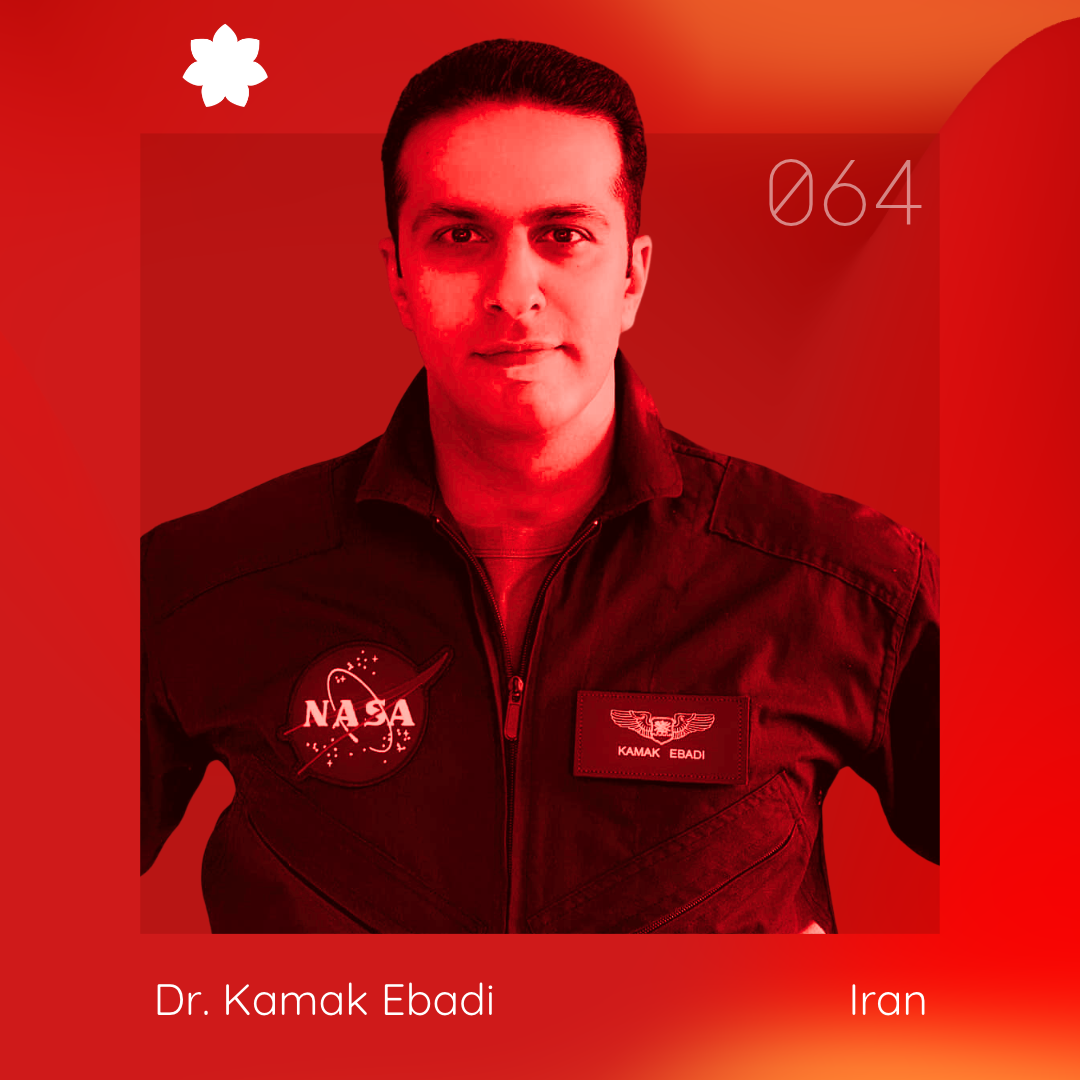
Seventeen emails. Nine years of overnight shifts. One seemingly impossible dream.
When Kamak Ebadi was growing up in Iran during the Iran-Iraq War, his earliest memories of space came from an unlikely place: the darkness of wartime blackouts.
As the lights went out across his city, Kamak's father would show him the stars, planets, and Moon, introducing him to a universe far beyond the world immediately around them.
Those moments sparked a dream that would eventually take him halfway around the world and into the heart of NASA's Mars exploration program.
This week on Aspiring Martians, I'm joined by Dr. Kamak Ebadi, a space robotics and autonomy engineer whose remarkable career has taken him from NASA's Jet Propulsion Laboratory to Blue Origin, where he now works on autonomous technologies supporting future human operations on the Moon.
But Kamak's journey was anything but straightforward.
Growing up without connections to the aerospace industry, he faced enormous financial and practical obstacles to pursuing a career in space exploration. Some people even considered his ambitions so unrealistic that they encouraged him to abandon them.
Instead, Kamak spent nine years working overnight shifts, saving money, pursuing his education, and looking for opportunities that might bring him closer to his dream.
Along the way, he found inspiration in Dr. Firouz Naderi, the Iranian-born NASA engineer who helped lead the agency's Mars exploration efforts. And after moving to the United States, Kamak decided to reach out to the man who had inspired him for so many years.
It took 17 emails.
What followed was a remarkable relationship that helped shape Kamak's career and eventually brought him to NASA's Jet Propulsion Laboratory.
At JPL, Kamak contributed to the Perseverance rover mission, helping operate the robotic systems responsible for collecting samples of Martian rock that scientists hope will someday be returned to Earth.
And in one of life's rather wonderful coincidences, Kamak discovered that his own perseverance had eventually brought him to Perseverance.
But his journey didn't end with robotic exploration.
In 2024, Kamak participated in NASA's Human Exploration Research Analog (HERA), spending 45 days inside a simulated deep-space environment to help researchers better understand the psychological, social, and operational challenges of human exploration.
For Kamak, the experience became especially meaningful because he had recently become a father.
Suddenly, the dream of traveling beyond Earth came with very real questions about separation, family responsibilities, personal sacrifice, and the people who support our ambitions.
In our conversation, we explore everything from childhood curiosity, mentorship, and the power of persistence to Mars robotics, spacecraft autonomy, astronaut psychology, and the emotional realities of pursuing ambitious dreams while raising a family.
Because while we often celebrate the extraordinary people who help humanity explore space, we don't always see the people standing beside them, the opportunities that made their journeys possible, or the personal sacrifices involved.
And perhaps that's the most important part of Kamak's story.
Not that he achieved something extraordinary entirely on his own, but that curiosity, determination, opportunity, and the support of others helped him build a future he could scarcely have imagined as a child.
Featuring