Just How Big Could Life Be On Mars?
What Earth’s caves teach us about life beneath Mars
30 May 2025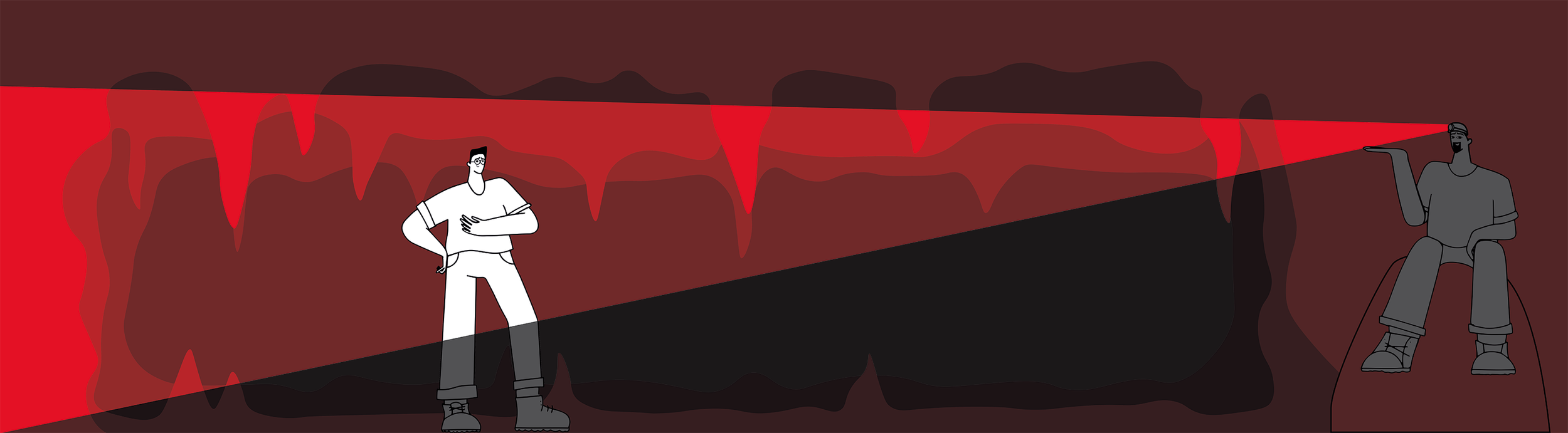
What lives here, if anything lives here at all, will not be grand. It will not roar from the shadows or leap across the passageway. It will cling quietly to stone, to chemical reactions, to the smallest trickle of water. And in your mind you hear the calm, unhurried voice of someone back on Earth who spends his life in places very much like this.
His name is Dr. Matthew Niemiller. And he has spent more than twenty years making friends with the dark.
The Far Places Beneath Our Feet
When Matt talks about caves, he does not describe fear. He describes serendipity. He says, “Yeah, yeah. It’s my, I guess, foray in exploration in the caves was, honest to God, honestly, my chance alone.” He had not set out to be a cave biologist. He had been a baseball player, an engineering student, a drifting undergraduate unsure of his direction. He laughed about that early meandering. “I partied a lot and wasn’t real focused as a student.”
But everything changed because one salamander was too small to hold a transmitter.
He tells the story often, and always with gratitude. His master’s project failed to produce enough salamanders to study, leaving him with nothing to research. But at that moment his advisor received a grant to reassess the conservation status of the Tennessee Cave Salamander. There was a need. Matt said yes. And the rest, quite literally, plunged him into darkness.
That first cave experience hooked him. “The first couple of times was a little bit surreal,” he said. “It was just like, oh, this is really cool, local habitats.” Something clicked. There were creatures here that almost no one had ever seen. “I’m seeing life that the vast majority of people on this planet have absolutely zero idea about.” In those early days he realized that caves are less like rooms and more like ecosystems hidden from the world.
And that mystery keeps calling him back.
Where the Darkness Begins
Caves do not wait politely to become strange. The transition from the familiar world to the underworld can be abrupt. “It can vary, but yeah, it can be really, really quick,” Matt said. Some caves plunge abruptly into darkness within a few feet. Others allow the slow fade of light as if easing visitors in gently. But once the light is gone, the rules of biology change.
Surface ecosystems run on sunlight. Energy arrives like clockwork. Plants transform it into carbon. Herbivores graze. Predators prowl. Nutrients flow through countless channels.
Underground life makes do with scraps.
Matt explained, “We’re either reliant on energy sources from the surface, things kind of washing in.” Leaves. Fallen insects. The occasional unlucky mouse. But the most reliable input in many caves is something less dignified.
“Poop is raining from the ceilings,” he said. Then he added simply, “Poop.”
Bat guano. Cricket droppings. Fragments of life from above. These bits of energy nourish fungi and bacteria, which become the base of small but persistent food webs. Crayfish. Salamanders. Blind beetles. Pseudoscorpions the size of commas. Everything fed by what falls from above.
That is Earth’s system.
But Mars does not have bats. Or crickets. Or any known photosynthetic life on the surface at all.
If something survives down here, it must live on the energy available in the rocks themselves.
The Slow Alchemy of Chemoautotrophs
When Matt talks about these chemical eaters, his voice turns gentle. They are tiny, ancient, and clever. They are the ones that might feel most at home on Mars.
Chemoautotrophs do not depend on sunlight. They use “sulfur, hydrogen, and iron” to drive chemical reactions. They mine energy from minerals. They breathe carbon dioxide. They build carbon structures atom by atom in the quiet darkness.
“You’re kind of getting access to other minerals,” Matt explained. “They’re kind of eating away at the rock, but not in the sense that we’re kind of familiar with.”
The process is slow. The energy yield small. And because energy governs everything in biology, the creatures that feed on these microbes must be equally slow, equally patient, equally efficient. Evolution trims away anything that costs too much.
Eyes. Color. Speed. Wastefulness of any kind.
In these dark zones, life becomes a whisper.
“In the real extreme situations, which maybe is probably what’s happening if there’s life on Mars, you have chemoautotrophic sources. So you’ve got organisms, probably bacteria or archaea, that are using inorganic elements like sulfur, hydrogen, and iron.”
The Strange Beauty of Troglomorphic Worlds
Matt has spent years cataloging the traits of cave life. He calls them troglomorphies. Loss of pigment. Reduction or complete loss of eyes. Elongated limbs in some species. Delicate sensory structures in others. Slower metabolisms. Longer lifespans. Fewer offspring. A subtle choreography guided by scarcity.
He explained, “Why have eyes, right?” In total darkness, vision becomes meaningless. Worse, eyes can become burdens. “It could be an area that can easily injured and lead to infection.” Over generations, eyes wither and vanish.
Pigment goes next. “Maybe it is expensive to produce these pigments,” he said. Underground there is no need for camouflage, no need for UV protection. Pale becomes the norm.
Life adapts to what it has.
It is easy to imagine similar adaptations arising on Mars. If anything has been alive here long enough, the same rules would apply. Small. Pale. Slow. Efficient.
The kind of life a scientist might overlook unless they kneel down and look very closely.
So How Big Are We Talking Here?
At some point in the conversation, the question emerged in full: what is the largest possible life form that could exist on Mars right now?
Matt did not hesitate. The answer was almost disappointingly small.
“If I was going to bet,” he said, “and someone told me, okay, there’s metazone life that exists on Mars, how big do I think it would be? I would still say maybe the largest because of the lack of the reduction in gravity and maybe on the order of a few millimeters.”
A few millimeters.
That is the size of a grain of rice. A fingernail clipping. A drifting speck.
Gravity might allow Mars organisms to grow larger bodies than their Earth equivalents. But gravity is not the limiting factor. Energy is. Without sunlight, without plants, without guano falling like rain, the entire ecosystem would operate on the smallest trickle of chemical energy.
A Martian salamander twelve inches long would require an entire economy of food below the surface. That seems unlikely.
But a millimeter sized creature feeding on chemoautotrophs? That seems almost reasonable.
Small is sensible. Small is survivable. Small is the natural end point of long isolation.
When asked to imagine opening a cave sealed off for a hundred million years, Matt paused. He considered Earth’s record. Most sealed caves have been isolated for tens of thousands of years, maybe a few million at most. Mars could have sealed systems older than multicellular life on Earth.
“Five million years is just a blink,” he said. And for Mars, isolation might stretch across billions.
In such long darkness, evolution has time to simplify. Time to refine. Time to produce organisms that resemble nothing we expect.
Matt admitted that his scientific caution coexists with sci fi wonder. “The sci fi fan in me likes to believe that maybe things will be really kind of odd.” But he also rooted his expectations in what Earth has taught him. “I would expect things to probably be pretty small and not necessarily real diverse.”
Still, he warned against certainty. “Never say never. There’s few absolutes in science.”
Mars has surprised us before. It will again.
“Size doesn’t matter. Relative to us as humans, that seems small. But relative to a single-celled organism, that’s a big difference.”
The Aliens Beneath
If a mission one day reaches a subsurface lake on Mars, the first glimpse of life may not come from a camera lens at all. It may come from environmental DNA. A technique Matt’s lab is refining on Earth.
“A lot of the work that we do now is actually trying to use environmental DNA to better detect and monitor a lot of this groundwater diversity,” he said. Once he explained it in a way that felt both scientific and oddly intimate. Every creature sheds DNA into its environment. Skin cells. Waste. Mucus. A trail of presence that lingers.
Even here in this cave on Mars, if something is alive, it may have left traces in the water. In the brine. In thin films along the walls. Detectable even if the organism itself is nearly invisible.
That may be the first Martian discovery. Not a creature, but a sequence. A signal in the water telling us that life still breathes somewhere in the dark.
At the end of their conversation, Matt said something quietly profound. “There are plenty of fascinating things to discover right here on Earth, a lot of mysteries that we need to uncover. So yeah, we’ve got our own little aliens that we still need to figure out right underneath our feet.”
He was talking about cave fish and blind salamanders and beetles no larger than a sesame seed. But he might as well have been talking about Mars.
If we find life here it will likely resemble those Earth creatures more than the beasts of science fiction. Not because Mars lacks imagination, but because life thrives in the margins. Because persistence is quieter than myth. Because surviving without sunlight shapes organisms into patient, unassuming forms.
Mars may hold extraordinary secrets. But even its miracles may be small.
Signal Received
If Mars holds life, it may reveal itself not in spectacle but in subtlety. A shimmer on a rock. A fleck drifting in a pool. A threadlike movement so slight that it feels like imagination. But that would be enough. A few millimeters of stubbornness surviving in the cold would rewrite our understanding of the universe.
And maybe of ourselves.
Mars teaches patience. It teaches humility. It reminds us that searching for life is not about finding something large or dramatic. It is about looking closely in the quiet places. It is about accepting that the universe may whisper its truths rather than shout them.
Somewhere beneath this planet’s dust, something may still be holding on. And if it is, even the smallest organism could be the beginning of an entirely new chapter of human understanding.
We only need to find it. *
Adapted from Joe Sweeney’s interview with Dr. Matthew Niemiller for the Aspiring Martians: Everyday Mars episode titled "Mars Cave Life" which aired on 27 May 2026.